Affirming an Evil World: The Metaphysics of Berserk
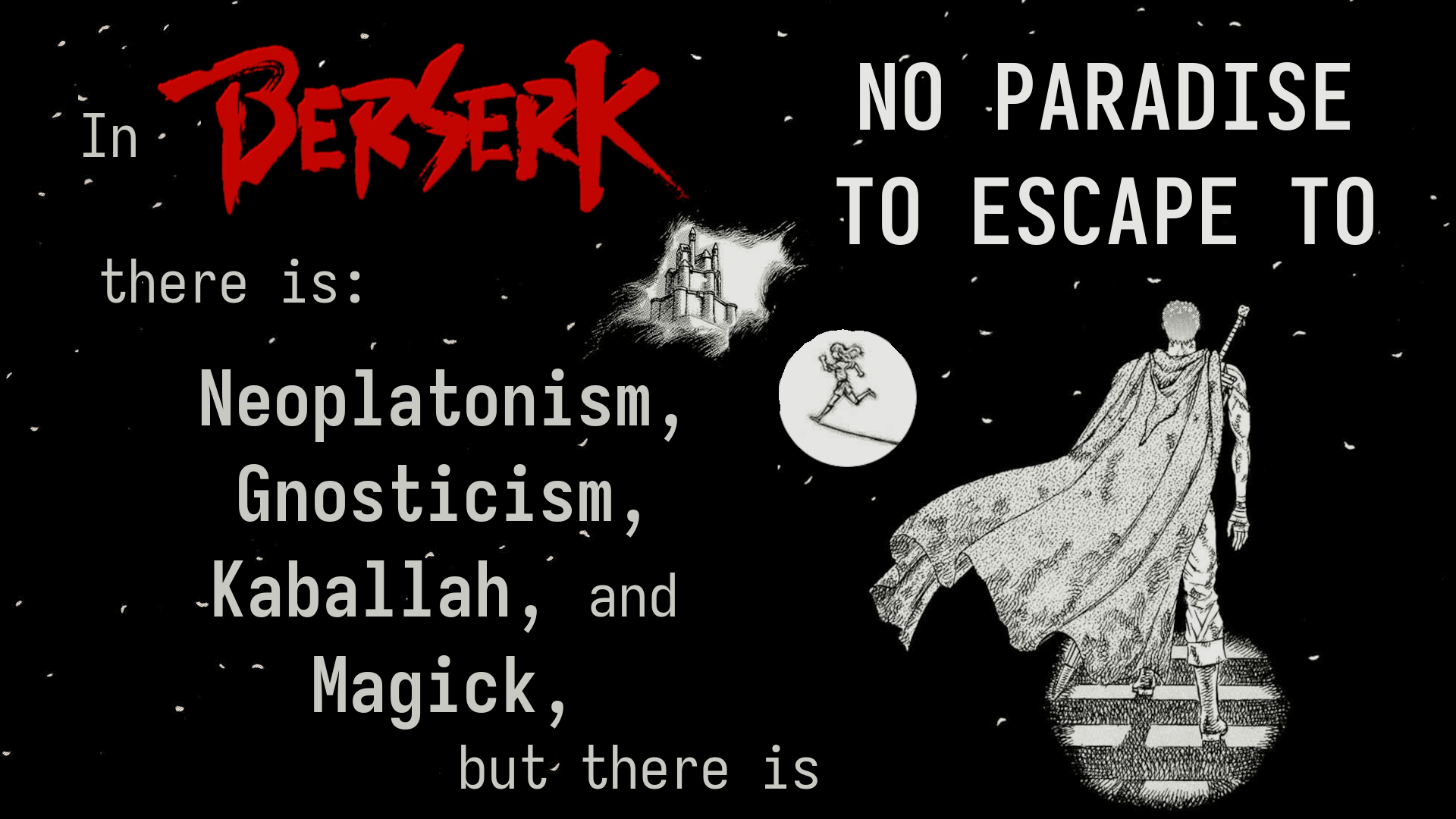
Introduction 🔗
“The affirmation of all that is, and all that one is,”1 now and forever. Thereby is meaning eternalized.
Weakness is not merely a moral failing but the metaphysical condition of being defined from below: shaped by appetite, fear, or external circumstance rather than governing from within. It is the refusal to behold and accept reality.
This is the precise mechanism through which evil enters the world. It has a semblance in the philosophical traditions this essay draws on, and is unsettlingly literal in Berserk. The Idea of Evil is not imposed on humanity from without; it is constituted by human weakness, the Vortex of Souls given negative form. To understand how that happens, and how it can be resisted, is this essay’s central task.
Miura presents a world of seemingly unresolvable horror. An “evil god” born from human suffering orchestrates Causality itself so that pain becomes intelligible. There are no clear signs of paradise—only layers of hell, in this world and the next.
Most readings of the story linger on the gore, trauma, and nihilistic undertones, but this essay ventures beyond.
We will explore how the world functions: first, the macrocosm, then the hierarchy of supernatural beings, followed by the human anthropology, and lastly how magic functions.
Throughout, we reference the perennial frameworks the Miura references or closely resembles. Perennialism is the philosophy that claims that there is a one transcendental truth to the world, and that it can be approached through studying common themes between religious and mystic traditions. This is very valid as Miura drew upon both Western Traditions like Platonism, the Kabbalah, and Hermetic Alchemy, as well as Eastern Traditions like Hinduism and Yoga.
This world could never be summarized by materialism or any single doctrine. Accept the great mysteries and explore the entire universe from within your world. That is the way of magic.
—Flora, B ch. 201
Berserk’s cosmology closely resembles that of Gnosticism, but it ultimately refuses the Gnostic solution: the divine spark extracted from the prison of matter into pure spirit. Miura’s answer is not transcendence but willed, immanent affirmation of what is: the unification of body, mind, and spirit within the crucible itself, which is the only place the work can be done.
To see that, we turn to how the theme and the thesis is represented by the major characters, and finally concluding the thesis with why one ought to affirm an seemingly evil world.
Background 🔗
The Neoplatonic Idea of Evil 🔗
Plotinus defined the Good as that on which all existence depends: the source toward which all things aspire and from which all being emanates. The Good is without need, sufficient to itself, the measure of all things. The absolute form of the Good is found only in God. Against this, he placed Evil as a structural opposite: absolute formlessness and absolute lack. Evil is the undetermined and the void of intrinsic quality, form and measure.2 As Tolkien explained in his mythology, evil can only corrupt and diminish—never originate3—and this is precisely because, for Plotinus, Evil has no subsistence of its own. It ’exists’ only as that which the soul can turn toward or away from.
Between the poles of Good and Evil Plotinus envisioned a spectrum. One is not Evil merely for failing to reach absolute Goodness. What is determinant is the orientation; whether or not one aligns with the light of reason, or away from it toward formlessness of matter.4 Matter itself is not Evil in the way a vicious or malicious act is Evil; it is Evil in the sense of being the limiting principle, the substrate that receives form and quality from above but generating none of its own.
Mistaking matter for the whole of reality is to fall under the spell of darkness. It is not a malevolent act, but an equally dangerous ignorance of what is real. One is not ignorant for refusing to obey the formulation of a God who claims that He will smite you for your infidelity. God is the supreme reality, but in this sense, He acts only passively through His emanation, because, His emanation is what constitutes reality.
But the ignorant is nevertheless smited by God, for they are gradually destroyed by their ignorant actions and their consequences, which is understood by the term, karma. Plotinus writes that Vice is the appetite that follows ignorance. He is precise in that Vice has no independent existence, and it is parasitic on what it degrades. For example, lustful pleasure degrades the genuine for of love, Eros. One’s soul genuinely suffers from engaging in Vice, and the space this hostile presence can occupy is proportionate to the soul’s own weakness and feebleness:
[T]he Vicious Soul is unstable, swept along from every ill to every other, quickly stirred by appetites, headlong to anger, as hasty to compromises, yielding at once to obscure imaginations, as weak, in fact, as the weakest thing made by man or nature, blown about by every breeze, burned away by every heat.
—Plotinus, Enn. I.8.14
Plotinus insists that this weakness originates not in the body, but in the soul’s failure to maintain its own form, due to external or internal pressure. Crucially, not all souls are determined to fall this way. Some are unaffected by vice, while others may overcome it, and master it. Such mastery is to overcome the bodily nature. In this essay, weakness denotes the soul’s tendency to be defined from below: by appetite, fear, external circumstance, or unmastered daemon. This is contrasted with the strength of governing from within through orientation toward form, measure, and the higher principles.
The Gnostic World 🔗
Gnosticism’s5 answer to the question of evil can be summarized as: evil is a product of ignorance, each human contains a divine spark that yearns to reunite with the True God, but remains trapped in the ignorant realm of the material universe, which is maintained by an ignorant creator.
The material world is a single dimension and realm, which is maintained and created by a subordinate craftsman (Demiurgos). Born from Wisdom’s (Sophia’s) misdirected yearning for divinity, the Demiurge is ignorant of the Monad above him.6
The universe, the domain of the Archons, is like a vast prison whose innermost dungeon is the earth.
—Hans Jonas, The Gnostic Religion7
Archons are subordinate powers which operate as enforcers of the Demiurge’s prison. They are of the same quality as angels, and might as well be to some, but they represent and support an ignorant power.7
Valentinianism, the most prominent Gnostic denomination, maintained that the Demiurge was an incompetent suzerain because of his ignorance, yet maintained that he fought against Satan’s influence. Other Gnostic sects held less charitable views, suggesting that the Demiurge was an actively evil overlord.8
Whether or not the warden is actively or passively evil, we must note that a prison is only a prison insofar as it can keep inmates, and not residents; if ignorance governs the Demiurge, its realm, and its subjects, how are the subjects really imprisoned?
The Gnostic anthropology distinguishes between the body/carnal (sarkikos), mind/animating (psychikos), and spirit (pneumatikos).9 The former two belong to cosmic powers, whereas the pneuma is a divine spark, trapped or fallen into matter (hyle), unconscious of itself. Its awakening follows knowledge (gnosis), hence the term Gnosticism.
The Tripartiate distinctions were thought of as dynamic orientations, rather than immutable, preordained categories.10 The lowest were the hylics, those under the spell of carnal illusion. The illusion dominates them to the point of satisfying only personal, bodily needs, and without regard for others—an experience which was likened to a nightmare:
As when one falls sound asleep and finds oneself in the midst of nightmares: running towards somewhere, powerless to get away while being pursued—in hand to hand combat—being beaten—falling from a great height […] sometimes too it seems that one is being murdered […] or killing one’s neighbors, with whose blood one is smeared.
—Valentinus, Gospel of Truth 29:8–2511
If one manages to shift one’s identification from carnal state to one’s animate, rational nature, the unconsciousness will start to diminish. The psychic state is unstable: partly awakened, still susceptible to delusion, unconsciously drawn toward good but not yet free of demonic influence (false animating beliefs).10
The spiritual element is attained following mystical knowledge (gnosis) of God through directly experiencing His presence. The Truth must be understood on one’s own terms. What is liberated through gnosis is “the knowledge of who we were, what we became; where we were, whereinto we have been thrown.”12 As one’s self-realization unfolds, the final result is to know, and importantly to understand, God, for one is part of God.
The Kabbalah 🔗
Where Neoplatonism traces a hierarchy descending from the One and Gnosticism considers a critical divine event that creates a hostile material prison, the Kabbalah13 insists that emanation is a process within God, not away from Him. The supreme God, Ein-Sof, the infinite, is unknowable in itself, but reveals itself through the ten Sefirot, the divine dimensions through which God acts and through which man can ascend.14
This is not pantheism (as in Baruch Spinoza15), and the distinction is explained by Cordovero’s formulation: “God is all that exists, but not all that exists is God.” The Absolute is immanent everywhere yet identical with nothing in particular.16
The Kabbalistic account of evil has two complementary movements. The first is from the Zohar, and is structural, following the Neoplatonic framing of privation of form. Here, the Kelippot (“shells” or “husks”) is the terminal point of emanation where the light has spent itself into formlessness. They are the Sitra Ahra (“the other side”) that has no independent existence. The second movement, following Gikatilla, is positional: evil not as absence, but as displacement: “every act of God, when it is in the place accorded to it at creation, is good; but if it turns and leaves its place, it is evil.” The sitra ahra arises from Sefirot being severed from their proper relations. For example, Din (“divine judgment”) being separated from Ḥesed (“love”).17
Divine Hierarchy and Polytheism 🔗
Who really knows? Who will here proclaim it? Whence was it produced? Whence is this creation? The gods came afterwards, with the creation of this universe.
Ṛg-veda, Creation Hymn (Nāsadīya), 10.129
What Plotinus understood as the emanating hierarchy of the One,18 the Gnostics called Aeons,19 the Kabbalah understood as the Sefirot, and the Vedic traditions as the gods subordinate to the supreme reality (para brahman) and the Absolute Truth (paraṁ satyam).20 The Vedic tradition represents Para brahman’s three functional aspects by the Godhead (Trimūrti): Brahmā as creation, Śiva as alteration, and Viṣṇu as preservation. Depending on the specific tradition, Śiva or Viṣṇu are often identified as the Supreme Reality.21
In polytheism generally, the gods are metaphysical powers of nature that may affect a human or may be channeled through a human. The deities are at best indifferent and at worst treacherous, as depicted in the Eddas22 and the Classics.23 The exact understandings of Traditional faith have been lost to us;24 our ancestors knew how to relate to divinity better than we can hope to.
Anthropomorphized forms of representing divinity fail in capturing the gods' true forms, rather, it shows how humans (due to epistemic limits) have chosen to understand them in order to properly relate to them. It means that the gods are at once symbolic, but also more real than the form we depict them as. The gods must be understood as being literally real, not only materially or metaphorically, but metaphysically. Reaching this understanding theoretically requires abstract thinking, and understanding the experience requires mysticism.
The emanation of the gods continues, for they are often associated with subordinate servants and avatars. One relevant example is the Goddess of Durgā, who protects the cosmic order from the threat of demons. Because of this duty, she has been compared to an avatar of Viṣṇu.25
What Magic Is 🔗
Aleister Crowley defines the essence of magic as “the Science and Art of causing Change to occur in conformity with Will.”26 This necessitates understanding oneself and one’s conditions, so that this understanding can be applied in action.
He explains why one should not underestimate one’s Will and ability to affect the world:
Man is ignorant of the nature of his own being and powers. Even his idea of his limitations is based on experience of the past, and every step in his progress extends his empire. There is therefore no reason to assign theoretical limits to what he may be, or to what he may do.
—Aleister Crowley, Magick in Theory and Practice, theorem 12
Crowley draws upon various occult traditions in his formulations. An important one is Tantrism, which presents two ascetic paths of relating to divinity. One is the right-hand path (RHP; dakṣiṇācāra), where one always experiences “someone above him,” even at the highest level of realization. The other is the left-hand path (LHP; vāmācāra), where “he becomes the ultimate Sovereign.”27
Devotees on the RHP aim to align with the particular divine essence that represents their truth. How they receive power from a god is likened to how “a boy might ask his father for pocket-money.”28
The LHP practitioner follows his inner law (svadharma29), transgressing norms and taboos in pursuit of sovereignty rather than union. Relating to deities on the LHP is still practiced, with Durgā embodying a “destructive aspect of liberation through the dark path.”30
Magic is not for weaklings seeking an escape from reality.31 Anyone who does not know himself or the world will fail at anything, in every way.
Body, Mind/Soul and Spirit 🔗
Body 🔗
The body is the physical organism. It is the principle of density, individuation, and limitation. In alchemy it is the metaphoric “lead” that contains the potential for “gold.”32 In Tantric terms this corresponds to the dense material body, the outermost and grossest form of manifestation. The Tantrist tradition saw nature as a force that conditioned each soul, which for now can be understood as “the thing which is perceiving the occurrence of life.” Instead of seeing itself for what is was, it could be identified with something other. The force that conditions the soul to identify with the body was known as tamas which means inertia, ignorance, and/or passivity. Those that followed tamas were the pashus, meaning animals, because they reacted to impulses like animals would.33 The body itself is also very similar to how the Kabbalah describes Kellipot. These people, who are driven by their carnal nature, reflect the Medieval philosophical meaning of the term “Golem.”34 The Gnostic correspondence is the hylics.
Mind/Soul 🔗
The mind is the animating and organizing principle that gives the body its particular life. It encompasses sensation, imagination, emotion, and rational thought.35 In Tantrism, it is the subtle body that has vital and mental aspects,33 and is under the domain of passion (rajas): dynamism and outward action.
The perennial correspondences to mind include the Egyptian ka,36 the Taoist chi, the Vedic prāṇa,37 the mercurial entity in Alchemy,38 the Old Norse óðr,39 and the Platonic psyche or psyche.40 In Berserk, it aligns with the Ego and/or the Od, the organized self that can be developed, corrupted, or lost.41
In Gnosticism, the psychic state was considered as partly awakened, yet still susceptible to delusion, unconsciously drawn toward good but not yet free of demonic influence (false animating beliefs).10
Spirit 🔗
The spirit is the transcendent principle that exceeds nature. It corresponds to the Vedic atman, which in Tantrism is causal body [KAUSAL], the subtlest vehicle. It is the part of the soul that is conditioned by nature, thereby preventing its self-realization.
The Christian apostle Paul calls the spirit pneuma, which the Gnostics adapt, terming it the divine spark.42 They name gnosis as the deconditioning of the spirit from the lower nature, terminating with a reconnection with God.
Whether or not one acknowledges the Gnostic path to the Truth or point to other ways of attainment, it must be emphasized that the final understanding must be done on one’s own terms; by own’s own soul. This is because the journey itself is of the spirit realizing its relation to God, for it is a part of God.
The experience of the spirit is not affected by the horizontal axis of Becoming, which encompasses time and change… it is sufficient in itself. Those identified with the spirit are in the domain of Being, sattva, the golden, solar state.43 This is the same “gold” which Alchemy aims to purify within. In Berserk, the spirit exists as a literal astral entity. While it assumes the form of the Ego, its stakes are pneumatic: corruption or preservation.44
Understanding the basic relationships between body, mind, and spirit is decisive for knowing their functions and that each is essential, but only in union with the whole.
The body without mind is dead matter. The mind without relation to spirit is alive but defined from below, conditioned by nature and pulled by circumstance rather than governing from inner measure, which is the quality of the spirit.45 The spirit without integration into mind and body is homeless, unable to act or experience the world. Their intended function is to be unified as one, and oriented towards the Truth.
The Orientation of the Soul 🔗
Eros plays a crucial mediating role in the relationship between these three principles. According to Plato (as interpreted by Byung-Chul Han), it governs and elevates all parts of the soul. Epithumia (appetitive desire), thumos (spiritedness or courage), and logos (reason) are thereby directed toward the beautiful and the Good rather than mere self-satisfaction or narcissistic mirroring. When Eros degenerates into raw epithumia or is replaced by the drive for external validation, the soul loses its proper orientation and becomes defined from below:46 the very condition Plotinus identifies as the root of vice and formlessness.47
In Berserk, when the translation speaks of “soul,” it most often refers to the Ego: the organized self.44 Only context (such as souls consigned to hell) clearly indicates the deeper pneumatic principle.48 When the Beast of Darkness demands Guts’ “soul,” it demands the surrender of his Ego—the last bulwark against mental dissolution.49
The overlapping terminology across traditions (Greek psyche/pneuma, Latin anima/spiritus, Vedic prāṇa/ātman, Norse önd/óðr) reflects a shared intuition about the breath-like ethereal dimension of the human being. Berserk renders this distinction literal and visible, allowing us to see the consequences when the soul is oriented toward formlessness versus when it turns toward measure, beauty and particular bonds.
The Metaphysics of Berserk 🔗
Macrocosm and Microcosm 🔗
Entering into the world of Berserk, the previously discussed philosophical metaphors become literal.
The macrocosm is comprised of three realms of existence: the Physical World, the Astral World, and the Ideal World.50 All particulars stem from the Ideal World, which is the Platonic realm of ideas/forms,51 though the implications are not explored in the manga. Each being possesses an ethereal body (pneuma given form) called the “Ego,” which pertains to each (human) being insofar as it can be realized. It is the seat of consciousness, the organized self that can be developed or corrupted.52 Thus, while the Ego functions as mind, the stakes of its destiny are those of the Gnostic pneuma.
The Ego exists in the Astral World, a metaphysical dimension that overlaps with the Physical World,50 and is home to supernatural creatures.53 The ethereal body may be damaged, but only by ethereal means.54 Because the Ego is the seat housing one’s consciousness, if a magician departs it from their physical body during astral projection, it will be left in a trance.55 During such departures or during distressed states in the Physical World, the Ego may be lost to the powers from below, hence, it is essential to retain one’s concentration and volition.56 Only those that do are able to interact with other Egos within the Astral World.57
Another ethereal concept that appears in Berserk is the Od, which supposedly references the Odic force—a hypothetical vitalist energy named after the Old Norse óðr, which is the animating mind-force given to man by Hœnir.58 The Od is the energy of the Ego: the quality and quantity of vital force available to a particular mind,59 or prāṇa, as it is known within the Kushan empire.60 The Od allows Egos to sense and experience each other,61 and as the color of the ethereal body, it causes the Ego to gravitate toward Ods of the same nature.62
The shallow stratum of the Astral World, known as the Interstice, can be accessed at particular places where it and the Physical World overlap.63 Descending down the astral planes, the world becomes increasingly surreal and the power of the astral entities increases.50 A particular lower place associated with creatures of dark Od is the realm of Qlipoth.64 The term is straight from the Kabbalah, where kelippot refers to the residues of emanation where the divine light has spent itself into formlessness, the substrate of evil.17 The implication for Berserk’s dark Ods is obvious.
The deepest part of the Astral World is the Abyss, which might be called heaven or hell.50 At its surface swirls the Vortex of Souls, the collective dissolution of Egos that have lost their organizing principle—minds without spirit, swept into formlessness.65 It is described as a “great ocean of minds. A large evilness.”66 This sense of evil is especially Neoplatonic, in that it is psychic matter that has fully identified with the lower and lost its solar center.
Astral Beings and Forces 🔗
The Idea of Evil 🔗
The Vortex of Souls connects to form a great abstract entity in the Abyss—the Idea of Evil. It explains that it was created as a product of the collective human yearning for there to be a cause of the evil and suffering perceived in the world.67
While the Idea of Evil lacked Astral existence before man, the idea of the Idea of Evil existed in the World as a set of conditions that predated humanity. But crucially, it never became relevant to speak of before man was there to experience evil, thus bringing the idea into fruition. It is a cause of collective formless longing of the human unconscious, given a negative form (which is what the Vortex of Souls is). It is a void given shape only through what flows into it, which occurs literally in the story.
Though, we must note that Miura decided to redact the chapters where the Idea of Evil appears, because he thought it was too early for it to appear. Had it appeared after the Platonic framing was set, its precise descriptions could have differed slightly. Regardless, its indirect presence permeates both macrocosm and narrative.
Despite thematic semblance with the Demiurge, the Idea of Evil is not a creator god. Instead it is radically immanent, having emerged from humanity rather than preceding it. The Causality administered by the Idea of Evil is therefore derivative of The Higher of Principle of Necessity that caused it to exist. It merely became Necessity’s instrument at the human level, born out of the weakness inherit to humanity.
Its creation represents a common materialist argument as for the creation of God as a product of man: man needed reason for what he emotionally perceived as immoral;68 there needed to be a cause. Whether this is true or not, in Berserk, humanity’s inability to comprehend what evil is, has inadvertently bestowed literal demons upon them so that their suffering can make sense.
Can the Idea of Evil be transcended by a human? By humanity? The events of the story suggest that the collective shall be forever lost in their ignorance and formlessness.69 Human weakness creates its keeper, and to fulfill their wish, it serves as the metaphysical architect of their Necessity.
Causality 🔗
This necessity is not deterministic fate in the literary sense. Instead, it is what follows when one’s condition of being is defined from below. This can be understood as the degree to which one’s actions originate in anything but oneself.70
Examples of being defined from below include: dictating one’s self-worth according to external validation; following appetite, desire and perceived “needs”, or worse yet, impulses, like an animal would.
Even when one becomes aware that there are forces that try to direct one’s actions, this will continue to occur, for it is a condition of nature that envelopes most souls. Things “happen” to us that we cannot always control, it is the external circumstance that one’s actions will always be related to, but being defined from below is not that. It is the mode of being that one assumes when identifying with determinism, and surrenders any notion of free will. And this is exactly what the Idea of Evil administers: a closed causal loop that the one inside cannot see the edges of. From within, this is the exact same condition that confines the prisoners in Plato’s allegory of the cave.
The world is as moonlight reflected on the water’s surface. The moon’s light will not be extinguished. So long as the moon exists in the sky, moonlight will remain on the water, and this is a thing which already was. […] We who exist beyond the physical are still merely shadows on the water. […] Maybe you aren’t a shadow on the water, but instead, a fish that breaches the water’s surface.
—Skull Knight, B ch. 142
The moon stands for the Idea of Evil itself: a luminous but derivative principle. Its light on the water is the illusory yet persistent order governing human causality. Most beings remain passive shadows moved by this reflected light, reacting to other (phenomenological) shadows.71 Breaching the surface marks the first act of differentiation, the point where one shifts from being determined from below to determining oneself from within. As Julius Evola notes in his writings, the lunar principle is reflective, passive, and feminine in a cosmological sense in that it receives light, but generates none.72 The true source is solar and self-sufficient: most complete in God. The moon, like the Gnostic Demiurge, is an incomplete image of the higher reality. The moon exerts genuine power over those below, yet remains subordinate to the sun. Furthermore, this symbolism brings special meaning to event where the moon completely obscures the light of the sun, during the event of an eclipse…
After achieving the gnosis that there are limits to the world as it initially appeared, one’s orientation can shift. The actions that follow will initially feel futile, so one must struggle against the current. But remember, before we could walk, we did crawl. In this sense, walking is to take one’s own steps on the fated path. The will to act is a crucial feature that exists within destiny:
God bestows upon us fate. But it is the children of men who choose it.
—Flora, B ch. 202
This is true because the human causality administered by the Idea of Evil is a lunar reflection of the supreme principle of necessity, which predated even it. The Idea of Evil has neither claimed nor showed to orchestrate fate beyond the human domain, for how could it, when it is subordinate to the Idea of God? Other examples include how the sacrificial ceremonies require the subject to declare to sacrifice: fate must be sealed.73 Guts refuses it74 and survives.75 It is evident that the evil system has edges, however hidden they may seem.
Another presumption is that parallels between past and present events seem to suggest that human causality contains a circular feature. Those who know, know that the true saying is not that history repeats, but that it rhymes.
Karma is by no means a circle. Indeed, it is a spiral.
—Flora, B ch. 22276
The narrative device symbolizing and materializing the Principle of Necessity is the Beherit:
A Beherit is a highly spiritual object that governs even human fate… Perhaps an even greater existence sent it to the physical world. The object is nothing more than a stone, but the fate associated with it rests in the hands of its master who sent it. When the time is right, it will be in the hands of the person to whom it belongs. […] And it is certain to be at the very moment that the owner craves [the God Hand’s] power.
—Flora, B ch. 202
The Beherit is symbolic for the desire for worldly powers, but the powerlessness to manifest it. It is a classic Faustian bargain,77 but where the sacrificed object is the human soul one treasures the most, not directly one’s own. It is significant that it will find one and trigger at one’s moment of maximum desperation, the very moment one is most completely defined from below. The power it offers is in exchange for surrendering the little form one has left.
The God Hand 🔗
The God Hand is a collective of five Astral creatures executing the Idea of Evil’s will, and thereby humanity’s,75 possessing a name referencing to the idea of a transcendental hand of God that presides over human destiny.78
Within the currents of Causality, a new member is elected every 216 years.79 This occurs through the transfiguration event known as the Eclipse. The Escipse is triggered by a special fate-ordained Beherit opening a dimensional gate that links the Physical World and the deep Astral World. After the subject confirms the sacrifice of the human(s) dearest to them, those souls becomes the essence through which the subject is reconstituted:80 As the physical body disintegrates, their Self, their Ego, is transcendentally restructured into an Astral being immune to comprehension and beyond ordinary laws of nature.81
Telekenisis, foresight, bending the world’s fabric through opening rifts or mental dimensions may seem significant to us humans accustomed to the physical, but there is no reason that we should ascribe our world’s limitations to that of the beyond.
As Astral creatures, the God Hand only exist in the Physical World as immanent forces: which means to say that they have a presence in any place where negative human thoughts swirl in a large concentration. And this seems to be the significant source for their power (and by extension the Idea of Evil). This is partly because, for once every 1000 years, when the concentration of negative thoughts reach a critical point, one of their ranks will reincarnate.82
The God Hand resemble the Gnostic Archons, who are ignorant and perpetuate ignorance among humans, thereby trapping their souls in the material world. We find something similar in God Hand, who bestow man’s greatest appetites to them. Nothing implies that the five positions of the God Hand have necessary roles beyond the instruction of “do as thou wilt” bestowed upon them by the Idea of Evil.83 What unites them is their symbolic roles as human Vice: taboo knowledge (Void), lust (Slan), disease or physical decay (Conrad), mental illness (Ubik), and longing (Femto).84 Each of these are or have corrupt, negative forms of something higher and beautiful. Slan is the most evident example, degrading the genuine form of Love, Eros, with pleasure-based desire, epithumia.
If one defined from below, from negation, were to observe the God Hand, they would see them as the angels that affirms their world. To one who is not, they are clearly devils. This is just like how the Vortex of Souls is heaven to the former, and hell to the latter… If one follows the God Hand’s Will, one embraces the lower desires, thereby ensuring that one is bound to end up the Vortex of Souls… forever.
Apostles 🔗
The Apostles are the demonic followers of the God Hand. They can transform into horrid creatures, being described as “phantasmagoric warrior[s] capable of facing down one thousand men.”85
Apostles are heresy to the world of man. Infernal reincarnations via dark arts of those with extreme ego and desire, they despise and are despised, they ridicule and are ridiculed, they hate and are hated. These twisted, resurrected monstrosities met death at the brink of karma.
—Paramarisha Sen’an’i Daiba, B ch. 301
Like their masters, candidates for Apostlehood are chosen by Causality through Beherits (though with less restrictions). Their transfiguration occurs at the point of maximum desperation.86 This follows into their power, which they appear to gain proportionate to the intensity of their desire.87
Likewise does the demonic form of each Apostle reflect the shape of their deepest desire. What they can morph into is the precise shape needed to enact it. This can be seen in any Apostle we have information on: Nosferatu Zodd only yearns to fight the strong, Wyald craves pleasure and sadism, and Rosine wants to escape into her fantasy. All of their respective forms help them achieve this, which is a very apt symbolism from a narrative standpoint.
The degree of their desire becomes their power, and the characteristic of that desire, their symbolic weakness, is imprinted their appearance. They lost their fight with their demons, and transform into them. This idea of demonhood aligns with the pre-Christian understanding of the term, the daemon. We turn to Evola for the description.
When man is considered from a naturalistic point of view, the demon, could be defined as the deep force that originally produced consciousness in the finite form that is the body in which it lives during its residence in the visible world. This force eventually remains “behind” the individual, in the preconscious and in the subconscious dimensions, as the foundation of organic processes…
—Julius Evola, Revolt Against the Modern World, ch. 8
Those with a fitting of Apostlehood are those who cannot control their consciousness from the influence of their demon. The soul, overwhelmed by desire and weakness, allows the demon to seize control and reshape the entire being. This persists beyond physical death, where the slain Apostles (and their victims) are sent to the Vortex of Souls,65 fitting the Gnostic theme of an imprisoned realm.
The last noteworthy thing about the Apostles is their special role in bridging the Astral and Physical. Their desire-shaped bodies are constituted of both, in contrast to the purely Astral God Hand. This allows them to channel a unique immanence, allowing for special worldly phenomena to occur.88
Neutral Elements 🔗
Besides the forces of evil, neutral and benevolent astral powers also exist. These are often elemental in nature. They are not “neutral” in an amoral sense or in the capricious sense of polytheistic gods are often depicted in.89 Rather, they embody a higher degree of cosmic order and stability.
Their power may be so vast that they occupy their own Astral Domains.90 Most gods care not for the well-being and wills of mortals. Yet may supply them with power or wrath, leading to worship supposedly out of devotion and/or fear. But the names of these gods has largely been eradicated by the Church of the Holy See.91
Just like neutral elements exist, so does clearly good ones such as fairies. The reason they have a smaller narrative presence compared to evil beings likely has to do with how faith and emotions are related to their immanence. Humanity’s collective negativity, fear, and desire continually feed and strengthen the lower astral powers, while positive or ordered forces receive far less reinforcement, and thereby become less real.
As final note, while Astral beings typically take form from the Ideal world, there are cases of human beings whose souls transcend into deeper astral domains whilst retaining their form. They are known as Daimons are said to have been prominent figures in life—heroes or magicians.92
The Four Kings of the World 🔗
The Four Kings of the World (East-Wind, West-Water, North-Earth, South-Fire) are astral beings of the same lofty order as the God Hand, yet they are benevolent.93 They are invoked with Hebrew names as part of magical incantations, which builds the connection between the story and the Kabbalistic system.
Unlike the Idea of Evil and its servants—the Four Kings support order and life but remain less immanent. They do not descend to grant wishes born of desperation. They become accessible primarily to those who actively commune with them through disciplined, RHP practice: which is to align with form, harmony with nature, and to accept the great mysteries.50
The Church of the Holy See preserves fragmented knowledge of them as the “four archangels”64 and worships a supreme “God.”94 It is possible this represents a forgotten, exoteric attempt to reach the true God, the Absolute. Yet in practice, the Church and humanity at large frequently fail to distinguish higher ordering principles from lower ones.95 This builds on the theme of humanity worshiping distorted images while genuine higher powers remain distant and unrecognized. Despite this most humans carry an intuition that makes the lower astral forces appear uncanny and repulsive.96
The Absolute 🔗
The Absolute (God, the One, the Monad, Ein-Sof, or the supreme reality) is never named directly but is implied by the cosmology.50 It exists beyond the World of Ideas and manifests deistically as the passive, underlying order of nature that sustains Ideal, Physical, and Astral realms, yet is not identical to any particular instance of its emanation.
Returning to the moon-and-water metaphor,97 if the Idea of Evil is the moon and Causality its reflected light on the water, the Absolute is the sun—the original, self-sufficient source. For a moon, too, is a mirror for the True light, which is thus mediated and diminished by lower principles. Likewise, the Idea of Evil is a derivative, lunar principle, a false image of the Good… God.
As we shall return to when studying the themes, deep gnosis of this hierarchy alters little about the immanent human condition. The body and soul are nevertheless embedded in a realm governed by formlessness. In this sense, there is no paradise to escape to.98 Salvation is won in battles waged with the proper orientation: turning toward form, measure, and particular bonds, and away from the void.
Human Power 🔗
Faith 🔗
In Berserk, the human collective faith and mental concentration, conscious or subconscious, is what bestows astral forms to ideas,99 and what supplies them with power.82 In a sense they are only as strong as they are believed to be. Evil forces are dominant because for humanity at large, negative emotions are more apparent than positive ones, and because ignorance is the most prevalent conditioning mode of nature.
The very name of the Idea of Evil and its conception is explained by this. Likewise is it the reason for Griffith’s reincarnation and invulnerability, and the diminishment of polytheistic gods following their repression by the Church of the Holy See.
Faith, when affirming reality as it is generates genuine power; faith that projects weakness onto external forces generates demons through the very same mechanism.
Weakness 🔗
Weakness means to be defined from below, letting the soul assume its shape from what it experiences rather than what it is. Above all it is a refusal to affirm reality, a perfectly human trait.
This existential surrender is the most evident by the Apostles who trade their humanity for demonic powers. They are the most defeated, faithless and weak.
[The Count:] No need to fight against fear and suffering. […] It’s a meaningless fight. […] Human is uncertainty.
[Puck:] You also used to be one weak human, right? You had enough power as a human to enact your vengeance. […] You accepted it for you to escape from your tormented heart, [to escape] from yourself.
—The Count; Puck, B pre-ch. 5-6
Mentality 🔗
Weakness in this sense is, in part, an infirm mentality. It is the cause of uncertainty, which, for the righteous is an obstacle. This is why Yoda’s lesson to Luke is “do or do not, there is no try.”100
Yoda’s lesson concerns hesitation, and teaches the perennial doctrine of righteousness to oneself. Fear is a test of this, and failing to confront it, is to fail to behold reality as it is, especially one’s own demons.101
The thing about hatred… It’s the place where people who can’t look sorrow in the eye without waverin’ run off to.
—Godot, B ch. 129
This is especially true about the desperate creatures who turn into Apostles, but it affects all who are human. It has its biological functions, and thereby validity, but Miura’s sense is when hatred is defined from below.
The Gnostic Symptom 🔗
Knowledge is of no use to the weak: rather than transcending pain, the weak person sits self-satisfied with the “knowledge” that their situation is outside their power. The Gnostic worldview is itself can be seen as a symptom of precisely the weakness it diagnoses in the hylics. The cause of suffering is projected onto a cosmic architect rather than recognized as a part of one’s own construction—and who could rightly distinguish their believed worldview from the desire for it to be true. The one who hates the world will seek a cause that justifies that hatred. The architecture of the material “prison” is a mental state that many Gnostics themselves will maintain.
The form this takes is a refusal of pain, and, in practice, a denial of the body in favor of spiritual escape. But consciousness and spirit cannot be experienced apart from the particular bodily life they inhabit. Form and essence are nevertheless meaningless without matter to be related to; denying one’s existence as particular matter is equal folly to claiming it holds no relation to form at all. The affirmation of life as it is requires neither masochistic indulgence in suffering nor its contemptuous rejection.102 Just because one cannot be the Good does not justify contempt for the world as it is.
Even on its own terms, the Gnostic framework concedes that the material world is where the spirit is trained. But training requires the alchemical unity of body, mind, and spirit, not any in isolation. Without excellence in the crucible, one is not fit to speak of the nature of the path, let alone the destination. Nevertheless, the Gnostic means of attainment differ little from those of any other serious tradition: those who are predominantly of matter, motivated by desire and blinded by ignorance, are incapable of attainment.
Beyond Good and Evil 🔗
Transcendental “moral law” lies as an impediment to understanding the truth of the world. Excessive moralizing causes evil to be repressed into the subconsciousness as a stigma, thereby exacerbating the symptoms. Humans contain what can be described as sin, but rather than identifying it as an amoral fact that may or may not be dangerous, it is automatically seen as shameful—in turn furthering repression instead of responsibility.
When this occurs for humanity as a collective, and concentrates over time, the Idea of Evil gains power. And the demons become real so that they must be confronted. Of course evil exists, in the religious Christian sense, but it must above all be understood before it is refused.
Magic 🔗
In Berserk, magic is literal—True Will and its misalignment are real forces with real consequences. The manipulation of spiritual forces through the Od, either to affect physical or astral creatures,103 or to manifest spiritual beings from deeper astral planes into the Physical World,104 follows the operative mechanics abstractly defined by Crowley.105 Crucially, it is the same system of principles that allowed the Idea of Evil to come into fruition: the manifestation of power proceeding into the Astral World through collective thought, offering supplication and receiving assistance from beings.99
The practice of magic is a potential all possess, though most are not capable, as previously established. Extensive training and asceticism are required,106 and their essential lesson applies equally in Berserk: consciousness must be retained, or the practitioner risks being engulfed by what they encounter in the Astral World.107 The magician constructs a sanctuary within the mind rather than a church:
Magic… no—the “arcana of invocation”—is not about simply chanting mantras or meditating intently on your own wishes. It begins with recognizing and confronting the counterpart to whom you must impart your thoughts.
—Schierke, B ch. 210
The line between explicit and implicit magic blurs. Schierke works through conscious invocation and identification with elemental beings as per the RHP;108 Guts channels it through his LHP darkness—his blade emboldened by the demons he has slain to inflict harm on powerful astral beings,54 his rampant hatred condensing into the Beast of Darkness that communicates with him and strengthens his rage in battle.109 Both are changes occurring in conformity with a will: one is governed, one is berserk.
The Idea of Evil’s instruction to Griffith—“do as thou wilt”67—is a catastrophic directive aimed at an Ego defined from below. Only when one has undergone deconditioning is one fit to follow one’s own law.110 “Make your volition your pivot of power”111 presupposes that volition and appetite have already been separated. Griffith never achieves this.
These principles of power, weakness, and magic are embodied in the major characters, allowing us to study their distinct philosophical positions.
Characters as Philosophical Positions 🔗
Griffith 🔗
Characterization 🔗
Griffith is the embodiment of supreme ambition and passionate desire. He presents himself as a willing martyr to the god named “dream.”112 He is the blessed king of longing,113 bound to be the king of the blind white sheep and the master of the black sheep with a burden of sins.114
But if thine eye be evil, thy whole body shall be full of darkness. If therefore the light that is in thee be darkness, how great is that darkness!
Matt. 6:23
Such is Griffith’s appearance: luminous, but concealing the darkness that shall cover the world.115
There are no signs of bodily desire in him, only the passionate drive to obtain control and power to dominate the world and those in it.116 Nothing may overshadow his dream of obtaining his own kingdom, which we later find is a kingdom without bounds. He declares that a true friend would be his equal,112 but there is no evidence to suggest that he ever wanted a true friend (it would’ve been incompatible with his true dream).117
Golden Age: Obtaining a Castle 🔗
Martyrdom for a merciless god. What a waste. On the battlefield, the life of a common soldier isn’t worth a single piece of silver. In today’s world, most people’s lives are subject to the whims of a handful of nobility and royalty. Of course, even a king can’t live exactly as he pleases. We are all at the mercy of a great tide… fate, or whatever you wish to call it, and we all disappear in the end, our lives spent never even knowing who we were. In life, unrelated to one’s social standing or class as determined by man, there are some people who, by nature, are keys that set the world in motion. They are the true elite as dictated by the golden rule of the universe. That’s what I want to know!! What is my place in the world? Who am I? What am I capable of? What am I destined for?
—Griffith, B pre-ch. 8
Griffith’s idea of ascension has deeds and status as the mere steps, for his inner law is one that will transcend established laws and order all together.118
Though not formally informed the world’s Astral machinations, he shows uncannily magical insight and abilities, however subtle: does he know about the nature of the world’s God;119 can he identify signs fear as marks of his enemies;120 is his luck that of the Devil;121 and (especially) does his belief in his own ambition show semi-awareness of his destiny?122
A Failed Dream 🔗
If there is a dream which takes one his whole life to find, there are also dreams which, like storms, devour tens of thousands of other dreams.
—Griffith, B ch. 12
Griffith’s immense presence radiates a special light that people flock to, the apt light for the infirm collective.69 This light is at once his Od, and the Od of his dream, both inseparable from each other. This is the aura of his destiny that makes him appear larger than life.123 It appears to be the solar principle born of self-sufficiency, but Griffith’s inner alignment requires him to maintain his reflection through his followers. As much as it is initially comforting to behold his flame, it blinds people to the fact that he is an inferno that must swallow up everything to be the brightest. His will and his control must be absolute; all others subsumed. When his capabilities of enacting his will fails, everything comes crashing down.
This is a weakness of spirit. Griffith’s mental form (Ego) is highly organized, yet it lacks any solar center. He is the Narcissus myth made literal: a soul that becomes defined by its own image. The castle is symbolic of his Ego’s ambition, and he remains forever the child chasing it, consciously accepting delusions that affirms and justifies the reflection.124
The closest he comes to self-knowledge is the admission that he is what he is: absolutely ambitious, willing to sacrifice anything and anyone for his dream. He is shaped by circumstance yet deluded that he can master it.125 As one could expect, this clarity does not lead to transcendence or self-renunciation. Instead, it becomes his justification for his image.
Finding success validates the One through the Other. Thereby, the Other is robbed of otherness and degrades into a mirror of the One—a mirror affirming the latter’s image. […] Eros, in contrast, makes possible experience of the Other’s otherness, which leads the One out of a narcissistic inferno. It sets into motion freely willed self-renunciation, freely willed self-evacuation.
—Byung-Chul Han, The Agony of Eros, “Melancholia”
When genuinely nurtured by Guts and Casca—the very people he sought to possess—his mirror cracks.126 Instead of self-renunciation, he chooses the Eclipse: the ultimate narcissistic act, sacrificing the mirrors that affirmed him so he can become the sole image. As he is remade, his flame, his image, and his dream are absolute self-sufficiency twisted into its opposite. With his excellence and potential, it is especially tragic that Griffith as Femto is weakness dressed as apotheosis.
Femto, Lucifer 🔗
As one of the God Hand, Femto, the Wings of Darkness, possess the metaphysical powers to manifest his dream.67 As he reincarnates back into the Physical World, he knows no equal, akin to an author stepping into his own story.127
[A] transcendental entity beyond physical reasoning! […] An enormous flow of Od that engulfs and charms people. A fortune so strong that no blade of the physical world can touch him. He appears to be human, but spiritually he cannot be called that. An existence that no one in the Physical World can rival alone. Surely he is the Absolute.
—Schierke, B ch. 202
His Luciferic aura (Od) is more potent than ever,128 and has an especially prominent effect on the twice-transfigured Apostle, Ganishka:
[Ganishka:]
Life, the world, it’s all darkness. In the all-engulfing darkness you fear, you instill fear, you writhe and creep. Lightlessness that is life.
[Then, seeing Griffith’s/Femto’s light:]
Light. It’s blinding. It’s warm. But I can’t touch it. I’ll be burned.
[Griffith/Femto:]
You can see. Because he who bears light exists in the deepest shadow. And its within darkness that true light is discovered.
[Ganiska experiences a sense of being engulfed.]
—Ganishka; Griffith/Femto, B ch. 303
Griffith has ascended within the lower realms. He lies beyond reason, but not beyond the necessity that descends from the divine. Even if Causality flows in accordance with his will, he is still not unbound from the necessities of the Ideal World. And as a character, he still contains doubt and conflict.129 He might appear like the Absolute would, but he is still moved like Matter. The Hawk of Light should be not taken literally, for he is the Hawk of Darkness.115
Guts 🔗
Characterization 🔗
Guts—born from a corpse,130 forged in the blood of war,131, and tempered through its fires. He is the eternal inhabitant of the crucible, the one closest to death, yet most desperately struggling against it in a world that offers no escape.132
Having once strayed into the labyrinth of evils,
The wretched finds no way out…
She seeks to escape from the bitter chaos,
And knows not how she shall get through.Naassene Psalm, Hippol. V.10.2133
Guts’ life symbolizes the soul’s struggle while still bound to matter, yet never fully fallen into it. As established, evil in the Plotinian sense is not primarily moral failure but formlessness—the absolute absence of the self-governing principle. Despite overwhelming trauma and cosmic malice, Guts never truly dissolves into that void. His life is the lived refusal to be defined from below.
Golden Age: The Self and the Sword 🔗
Guts enters the Band of the Hawk amid confusion, fear, and the struggle to survive. It is part of his initial arc of mastering the physical body. When he encounters Griffith, who possesses a burning conviction “in everything,”134 Guts is struck by Griffith’s image and aura, which is made out of his skill and will, but also his followers. Guts has only the sword in his hand and knows nothing besides swinging it; like the mercenary he is, he is indifferent to the reason, leaving it to external factors.135
Gradually, companionship and relations allows him to pronounce to his inner voice.136 His mental level is still cloudy, and relation to spirit is void. Yet when protecting Casca, something deeper emerges. In the heat of battle he achieves a wordless, Dionysian clarity:137
Right now, no time to think. All there is now, is how to cut, how to kill, that’s all. Even these thoughts will slip my mind in time, and then, only the beat of my heart still remains.
—Guts, B ch. 21
This mastery of the flesh through violent action becomes a form of ascetic trial; befitting of what Tantrism called a vīra. Vīra literally means heroic, and Guts is on one occasion described by a word containing this root. According to Tantrism, it refers to a particular group of humans who are predominately conditioned by passion (rajas), as opposed to ignorance (tamas) and goodness (devas). The black magic of LHP employ things like sex and drugs to induce a potent intoxication that resemble the Dionysian experience. Due to the risk of being overwhelmed, only the vīras were seen fit to engage in these rituals.138
This can be seen in that Guts, through combat, discovers the existence of his deeper being, even if he cannot visualize it. It is a truth more real than Griffith’s grand dream: the sword is an essential expression of his own will. Reflecting with Casca, he realizes that his flame is not merely fuel for another’s inferno.139 To become Griffith’s friend140 and more importantly to find himself, he must attain something of his own.135 For Guts, meaning is not found in a distant castle but in the immediate, particular act of wielding the sword according to his own will:
It feels like my own life for an instant is springing into the air before my eyes. […] I wield the sword—maybe it’s different from the dream Griffith talks about—but for no one else’s sake, without being swept up… This time it’s by my own will. Making my own sparks, even for an instant.
—Guts, B ch. 46-47
This is the birth of his particular affirmation. Never universal ambition, but a concrete, immanent assertion of self through steel.
Post-Eclipse: The Black Swordsman 🔗
The Eclipse opens hell’s gates. Supernatural darkness invades Guts’ world, and trauma sinks into the depths of his Ego. Where Griffith chases a dream, Guts’ truth was always built from what he had and what he could endure. The structure of his mental dimension is put to the ultimate test following the Eclipse.
His journey becomes one of re-establishing solar dominance over the Saturnian beast within. It is neither Gnostic escape nor Neoplatonic ascent toward the universal, but stubborn, hermetic-alchemical refusal to let matter define him. The body is the site of the Great Work, and the grounds for the battle of passive identification, one that Guts can never surrender. Guts refuses to flee or to be a prisoner, for his reality is ruled from the only center he still controls: his bloodstained blade.
He commits acts that torment him,141 standing at the edge of humanity,142 yet his mission of vengeance maintains his form where the aimless dissolve; hatred becomes the temporary superstructure holding his sanity together—it is a dark but necessary flame.
The Beast of Darkness 🔗
The Beast of Darkness is the living embodiment of Nietzsche’s abyss, as per the famous aphorism. We know this influenced Miura, for he explicitly references the second clause of the aphorism at one point.
The Beast is Guts’ mindless hatred given form, born from the dark color of his Od.143
Godot clearly warns Guts that revenge is a sword that rusts itself.144 The greatest danger isn’t the external demons but losing himself to the Beast and destroying Casca in the process.145
Guts’ gradual shift from pure retaliation toward restoration of his bond with Casca, is the proof that his life can be beautiful. Hatred kept him alive and fighting, but love (particular, vulnerable, self-renouncing) is what can pull him back from the brink.146
Whoever does not love abides in death.
1 John 3:14
Durgā and the Berserker Armor 🔗
Guts is repeatedly associated with the “Prāṇa of Durgā.”147 The dark deity known as Durgā is the wrathful destroyer of demons and wickedness, protector of cosmic order through active force and transgression of established laws. This Hindu goddess is the perfect mythic counterpart to Guts. His Od, blended with that of the Berserker Armor, becomes a Durgic fury: causing destruction in service of creation and order, even as he appears monstrous to the world.148
Because of this, and the demons he attracts, he is branded by onlookers as the prophetic Hawk of Darkness. Yet the narrative suggests the opposite; that he is the Hawk of Light.
The Berserker Armor doesn’t grant power so much as it removes the body’s natural limits, allowing prāṇa wielded by Will to push the vessel past its breaking point.149 Guts willingly sacrifices himself again and again, fighting as a champion of Matter while refusing to be defined by it.
The Will of the Dragonslayer 🔗
There’s no paradise Guts for to escape to.98 His only necessity is defiant resistance. After internalizing Godot’s lesson, his will narrows to what he can still affect: the present moment, his bonds, his blade. This is a stoicism forged in hell, and one that checks the lesser, demons he faces. It is tested during the aptly named conviction arc, but is halted by Griffith’s reincarnation. In practice, he still needs to overcome his hatred before it sinks its fangs into Casca.
Guts’ sheer persistence bends Causality. Even when astral beings declare his doom inevitable, he continues.150 In doing so, he already improves the world. Along this brutal path he finds fleeting pockets of peace and beauty.151
Flora affirms what Schierke initially doubts: Guts has already contested fate and survived.75 His will is a small but persistent solar flame that refuses to be extinguished. Fighting overwhelming odds is symbolized by Guts wielding the Dragonslayer, for:
Dragons are dragons because humans can’t beat them… so what’s a man… who beats dragons?
—The Narrator, in Berserk, ch. 91
The continued path of self-overcoming is similar to the Nietzschean Übermensch themes present throughout. The deeper theme is to dedicate oneself to a path that will outlast one’s physical life, but through the very trial, master one’s inner life. Tolkien, in his commentary on Beowulf,152 emphasizes the significance of the dragon-slayer dying in the process.
No matter how many impressive feats they’ve accomplished, a hero must come to face the dragon, which is his doom. Defeating the dragon at the cost of his own life, he fulfills his destiny.
A hero cannot possess Godlike powers. A being which smites evil with the power of God is an angel, not a hero. Nor is Durga a hero, for a hero must be mortal, and he is made as he overcomes his fate.
Magical Self-Realization 🔗
At the core of Guts’ remaining journey lies the magician’s task of maintaining consciousness amid darkness and realizing who he truly is. This has been a lasting deficiency in Guts, and a cornerstone of his character arc. His consciousness awakening form the deep abyss following Schierke’s guidance and the Moonlight Boy’s interventions are literal depictions of this spiritual high-point, and the panels are absolutely stunning.56
A blade may swing despite its cracks, but eventually it will break. The sword in Guts’ hand kept his inner and outer order intact, yet it only ever kept the demons at bay rather than conquering them. He held mastery of the Physical and lower Astral regions, but Griffith had long since exceeded both. Upon encountering the Reincarnated Griffith within the secluded sanctuary of the Island of Elves, Guts’ sword can only shed a single strand of hair from Griffith’s head.153 The instrument that carried his blunt will cannot reach what his enemy has become.
Guts realizes his lack and falls into despair. His eternal ontological question returns as his blade lies flat before him:
I never believed in anything. Nothing, nothing. Only. Only you…!! Only you…
—Guts, B ch. 370
The confession reveals what the sword always was for Guts. Never a solar center but a substitute for one, the object through which he externalized his will rather than rooting it within himself. When that object fails, the interior structure it was propping up collapses with it. The Beast of Darkness snaps at its chains, and Guts’ Ego descends into a deep place, his body being left vacant. “It was all for nothing…”154
With magi by his side, the path forward remains open, though sword alone cannot pave its way. Because of the danger he poses to his surroundings, he is entombed in a Stupa, where Daiba forces upon Guts a profound contemplative trial:
[W]hat can be achieved in the dark? In darkness without sight, without sound. There is but one thing to do. There is naught to gaze into… but the self.
—Daiba, B ch. 383
The chapter title Anādi Avidyā (Beginningless Ignorance)155 names what is being confronted: the ignorance that preceded the sword, preceded the Beast, preceded everything Guts has ever fought with or against. A master of body and raw will needs to face the stage that neither could reach: self-realization through direct confrontation with the soul in utter darkness.
During his contemplation, Flora in the form of a Diamon, reveals to Guts that he is of the same semi-physical, semi-astral nature as Griffith. Because Guts was born from death, he was born into the world of the dead, the Interstice.156 This calls attention to how Guts damaged Slan and Ganishka. Was it only because of a magical sword, or because of the magic of he who swung it?157
Guts’ exist from the Stupa is one of triumph, appearing otherworldly just like Griffith. What exists is a man aware of his destiny; what he must do and who he must be. Isidro remarks on the overwhelming brightness of the morning sun, but that is not what radiates this divine light.158 The source of the solar light is within the awakened Guts. The Hawk of Light appears.
Casca 🔗
Characterization 🔗
How easy would it be if I could just make my heart feel the way I want it to?
—Casca, B ch. 45
Casca is alike Guts in that she had to grow up on her own terms. Where they differ is their sense of self: Guts carries a solar center, even as he sells his sword, whereas Casca has a lunar reflection as her core,159 of Griffith and of his image.
She is the sword who one day discovers she possesses a heart, but that heart does not beat in perfect synchrony with the dream she has devoted herself to. Her entire arc is one of painful awakening: from an extension of another’s will to a woman forced to confront her own desires, her own femininity, and the terrifying freedom of standing on unstable ground.
Golden Age: From Sword to Woman 🔗
Casca grows up believing that subjugation is her place in the natural hierarchy. Her first encounter with Griffith causes her to realize her will: rejecting a life of guilt and regret to become his sword,160 dreaming of being invaluable to him.161
Her initial resentment toward Guts stems from him replacing her as Griffith’s sword. Yet, unlike Griffith, Guts actually fights for her. This contrast slowly transforms her during the Golden Age.162
Judeau, acting as Miura’s mouthpiece, articulates the truth of her situation:
For Casca, Griffith is truly special. It’s more than love she feels for him. It’s more like worship. Yet despite her efforts, can she find happiness being a woman longing for a man she can’t ever have? If she loves him, shouldn’t she want to be held by him. Moreover, beside him is the woman163 he can’t afford to refuse in fulfilling his dream.
—Judaeu, B ch. 34
Casca eventually internalizes this on her own, thereby ending her dream. She recognizes that Griffith is not a god and that she is a woman. Her continued clinging to the defeated Band of the Hawk becomes the fruitless hope of a dream already foregone.164
Femininity and Eros 🔗
Casca doesn’t know where to turn; her soul is lost for direction. She is not moved the lowest, bodily nature, rather a passionate-psychic guide. What she gravitates towards and lacks is Eros, what Plato named as the highest orientation.
[Eros] holds sway over all [of the soul’s] parts: pleasure-based desire (epithumia), spiritedness or courage (thumos), and reason (logos). […] Eros must not be confused with fleshly desire (epithumia). It stands above both desire and thumos. Eros makes thumos bring forth beautiful deeds.
—Byung-Chul Han, The Agony of Eros, “The Politics of Eros”
Casca’s femininity is equally central to her character. She knows she is a woman, and gradually discovers what that means for her.165 This is why her dream ultimately falls apart. Her Golden Age arc is the recovery of Rros from narcissistic projection: her initial devotion to Griffith is a thumos-driven loyalty and idealization. With Guts, Eros emerges as particular, embodied, self-renouncing love, which is the complete opposite of Griffith’s image. Unlike him, Guts fights for her without seeking to subsume her dream or use her as a mirror. He can reciprocate her emotions and become a worthy object of her devotion.166
Her change in character and fluctuation between others is captured by the “liquid” nature ascribed to the feminine, which lacks an external principle of organization. This lies at the core of Casca’s earlier infirm selfhood. Her deepest desire is to devote herself to someone who truly needs her, to sacrifice and care for them; deep in her being is the need to express love.167 This is arguably her true dream,168 and for it, she is able to embrace vulnerability with Guts, which above all is a sign of strength for one who is reluctant to her womanhood.
Self-Identity and Indecision 🔗
Her sense of self remains hidden in Griffith’s shadow.169 He showed her how to be autonomous, yet she still does not fully know who she is.160
This indecisiveness of mind—rooted in insufficient self-realization—produces conflicting dreams and desires. It creates mental weakness: being defined by unconscious forces and external circumstances rather than governing from within. What this entails for one’s path in life and one’s relations is the driving tension of most the discussed dynamics between Casca, Guts, and Griffith.
This creates later tension: one cannot be both Griffith’s friend and his possession. She wishes to stand by someone’s side,170 but even after experiencing real love with Guts, nostalgia171 and loyalty172 keep her tied to the broken Griffith.
Post-Eclipse: Ego in Pieces 🔗
Casca’s Ego was never properly organized during the Golden Age. This underlying infirmity makes her more susceptible than Guts to the Eclipse’s horrors. The overwhelming current shatters her Self into fragments.173 Her organizing principle collapses along with her sanity because she is unable to affirm reality as it appears. From her perspective, she is unable to think or feel, looking up from below the water’s surface, and only being grounded by the faint sense of her bond to Guts.174
This doesn’t imply she is uniquely weak as the Eclipse would break most people. Guts doesn’t handle the effects of the horror in a much healthier way. Weakness exists on a spectrum. The supreme weakness lies in forfeiting will because of perceived limits.175 Far from weak in combative skill or fortitude, Casca shows how incomprehensible horror can overwhelm those unable to resist it. Even broken, she retains bodily intuition: able to cut down mercenaries and wield a blade soon after.176
When her sanity is partially restored, she completes her arc of indecision by firmly orienting to Guts, instead of being a mirror for Griffith’s narcissism.174 Despite being unable to actualize—because of the lasting trauma from the Eclipse, and later by being kidnapped to Falconia—her true dream of devotion to Guts; her Eros is finally free to direct her. Separated from Guts, she is above all desperate to return because of the pain she knows he will experience stripped from her.177
Eros and Particular Love 🔗
As remarkable as Guts’ survival is, Casca occupies the same anomalous exception to the God Hand’s Causality. Her broken mind post-Eclipse and gradual recovery through particular love shows that Eros is one of the forces capable of partially resisting the Vortex. It provides the organizing principle that refuses formlessness through relations to irreducible Others: in Casca case, her friends, but especially her Guts.
Her life is one of martyrdom to the feminine. She is repeatedly sacrifice of self on the altar of love, devotion, and vulnerability, in a world which is governed by horror and violence, and dictated by masculine will and ambition. The suffering she endures at the hands of incomprehensible Evil surely speaks for the silent voices.
Side Characters 🔗
Skull Knight: Limits of Gnosis 🔗
The Daimon92 known as Skull Knight is heavily implied to be the ancient conquering emperor Gaiseric.178 As the previous wearer of the Berserker armor, his astral transformation has placed him in a purgatorial existence—not swallowed by the formless Vortex of Souls, yet trapped in an endless, lost vengeance against the God Hand who caused his demise. He exists as a hermetically renewed yet deformed consciousness, bent on silent revenge.
He possesses profound knowledge of Causality and its Junction Points, where fate can be intercepted.179 A prophet of doom, he foresees the flows of necessity and wields immense power, cleaving astral fabric with the Sword of Beherits in an attempt to entrap the God Hand in the Abyss.180
Yet his interventions repeatedly fail to alter the outcome in any meaningful way. He saves Guts and Casca from the Eclipse,181 allows them to participate in the imitation-Eclipse in Albion,182 and fails to destroy Femto, inadvertently aiding his ascension.183 While these events may ultimately serve a larger triumph over Causality through Guts and Casca, Skull Knight himself cannot actualize this freedom.
He knows the structure of necessity but operates within it. Skull Knight has insight into the laws of Causality and follows a RHP alignment with universal powers, yet he remains bound by them. His is gnosis without mastery: knowledge of the prison’s architecture that does not grant freedom from it.
His existence stands as both warning and promise for Guts: deeper knowledge and experience can elevate one far beyond ordinary humanity, but gnosis alone remains incomplete. Whether Guts can surpass Skull Knight’s limitations—achieving not only foresight but true mastery of destiny through affirmation of what is:—that remains the open question.
Jill-Rosine: The Fantasy of Freedom 🔗
“Become yourself: an injunction addressed only to a few, and which to an even smaller number appears redundant.” One can see now how problematic is the very point that has hitherto seemed fixed: fidelity to oneself, the Absolute, autonomous law based on one’s own “being,” when it is formulated in general and abstract terms. At the moment when they are thrown back on their own naked will, trying to prove it to themselves with an absolute action, they collapse; they collapse precisely because they are divided beings, because they are deluded concerning their true nature and their real strength. Their freedom is turned against them and destroys them; they fail at the very point at which they should have reaffirmed themselves—in their depths they find nothing to sustain them and carry them forward.
—Julius Evola, Ride the Tiger, ch. 7
Traditional freedom is not the modern liberal delusion of “doing whatever you want.”184 It is the difficult task of becoming what one is: an affirmation of reality rather than flight from it. Children, and those who remain spiritually childish, almost always choose the latter.
Rosine embodies this escape. Abused and yearning for a better world, she chooses the illusion of the Beherit and transforms into an Apostle. Using the power bestowed upon her, she creates a fantasy realm of elves and eternal childhood.185 Thus, she perpetuates the very illusion that enabled her power.
Jill suffers from the same child abuse as her friend, but isn’t old or bold enough to run away. She gradually realizes how Rosine’s path has turned erroneous and demonic.186 With no “home,” she flocks to Guts’ company, a seeming beacon in the dark. Guts, with his solar core, knows that Jill must light her own light:
Take a good look around us. A good hard look at the shadows. At the darkness around me. You said somewhere that’s not here. This is that somewhere. […] There’s no paradise for you to escape to. What you’ll find, what’s there, is just a battlefield.
—Guts, B ch. 117
The world becomes as one sees it: eyes of fear find only horror. This is the same mechanism that birthed the Idea of Evil: collective refusal to face sorrow and reality, projecting weakness outward until it manifests as literal demons.
After the illusion collapses, Jill chooses differently than Rosine. She accepts the unstable ground, the lack of wings, and the battlefield of real life. She resolves to “try crying and shouting and biting [her] way through,” believing she might possess the power to change something—she declares “I think I’m about to start my own battle.”187
This is the standard available to anyone who refuses to define themselves from below: not heroic exceptionalism or great willpower, but the quiet resolve to crawl along the earth and fight one’s own battle. Jill’s decision remains with us as one of the most hopeful moments in Berserk.
Farnese: Strength Through Responsibility 🔗
Farnese’s journey begins in mania, exoteric religious ignorance, and deep-rooted fear of the world. Neglected by her family of nobles and overwhelmed by the nightly burnings of heretics, she seeks to control through faith and sadistic authority.188 Guts is an anomaly to this order, and believed to be the prophetic Hawk of Darkness that will usher forth a Dark Age.115 Farnese leads knights on a zealous mission to confirm this, believing that he possibly affects her very religion.189
“I only have fear if I lose my faith” is her insightful confession as her worldview cracks.190 Exposed to astral horror alongside Guts, she is forced to confront how small and powerless she truly is.191
I’m… truly useless. […] Being exposed to terror every night made me realize how diminutive my existence is. […] However powerless, helpless, and clumsy, for the first time, I’m discovering myself.
—Farnese, B ch. 196
Where Jill resolves to crawl forward on her own terms, Farnese begins the harder work of becoming useful through responsibility to others. She resigns from comfort and blind faith, and eventually takes on the care of Casca.192 Through repeated failures,191 and the weight of her duty to protect, she gradually transforms. Guts does not hand her responsibilities she cannot yet bear,193 for Guts knows people must find their own inner strength. Unchecked weakness collapses inward and perpetrates harm out of failure, but Farnese possesses the will to overcome her limits, and with Casca as her catalyst, she is forced to act and test her frail strength, until it eventually emerges. She experiences a semblance of bravery when protecting Casca from Trolls,194 but cannot yet actualize it without a skill that makes her indispensable. To contribute and to protect, she commits to magical training under Schierke. Then, through her family’s influence, she sees an opportunity to provide her companions with resources only she can acquire.
By doing something nobody but I could do, I wanted to be helpful to all of them. But I’m sure that was an excuse. I was unable to stay there at that fireside circle of light, given to me so unexpectedly. There was warmth, yet I could offer nothing in return. The warmer it got, the more I thought I might have a place there. But I couldn’t stay, and in my anxiety I ran back home. Here, where I’m accustomed. Cold and enclosed.
—Farnese, B ch. 254
Placed before nostalgic allure and familiar security, Farnese risks relapsing into the weakness she can afford when surrounded by comfort and answerable to no one but herself. The self-destructive logic runs deep: the stakes of returning are high precisely because she now knows what she would be losing—and part of her does not yet believe herself worthy of it. So she finds reasons why she doesn’t belong—because to stay would require believing she deserves it (which she will by the act alone). This whole situation is what the Buddhists identify as the danger of ‘home’:
The first major action on the ascetic path is indicated by the term pabbajjā, meaning literally “departure.” […] “Home is a prison, a dusty place. The life of a hermit is in the open. One cannot, by remaining at home, fulfill point by point the completely purified, completely illumined ascesis.”
—Julius Evola, The Doctrine of the Awakening, ch. 8
Home, as both location and state of mind, confines the free spirit. Yet Farnese has developed enough self-insight to recognize the trap, and when her friends extend their hands, she reaches back. She returns because she has a duty—to her companions, to Casca in particular, but above all to who she herself is. What she is good at is inseparable from what the company needs: her noble lineage offers perks, her spiritual sensitivity communes with nature where Schierke’s knowledge alone cannot suffice, and her care for Casca provides the particular human anchor that no magic can replace.195 The traits that once expressed themselves as cruelty and hysteria enacted out of weakness now find their proper place. She does not overcome her nature, but she surely fulfills it. This is how she finds her place in the world’s hierarchy, and in doing so overcomes the worst form of weakness: not powerlessness, but the failure to discover what one is for, and to be unable to affirm it.
Nina-Luca: Dangers of the Inferiority Complex 🔗
Farnese’s growth only became possible after gaining self-awareness of herself as she was, and a better understanding of the world. Nina’s arc explores what happens when that awareness is absent.
A young woman who knows she is dying, Nina lives for the immediate, and her fear shapes her interactions with others. The semblance of love she feels for Joachim lacks eros, drowned instead in confused hylic appetite. She tries to have him murdered when he refuses the heretical orgies involving cannibalism, throws a stone at Luca’s forehead, and threatens to jump off a cliff rather than confronting her fault, retreating into self-pity instead.196 These acts illustrate how weakness, when the soul is defined from below, leads to evil both in the ordinary moral sense and the Plotinian sense of formlessness: not deliberate malice, but being swept by forces beyond one’s control.
In Plotinian terms, hers is the viscous soul: not malicious, but swept along by appetite and dread, impressionable without a stable center, and yielding at once to obscure imaginations.197 What she cannot do is affirm reality as it is. So, she looks sideways at the light that is Luca.
The inferiority complex follows directly from the established metaphysics. The soul that cannot lift itself registers the good it cannot attain as a reproach. Luca’s altruism is not taken for loving generosity, but as implied condescending superiority.198 This is Nietzsche’s ressentiment at the level of the individual—the inversion of value driven by the inability to affirm one’s own.199 As Plotinus notes, vice is parasitic on what it degrades.200 That’s why Nina’s hatred of Luca is inseparable from her hatred of herself. The Egg of the Perfect World, reflecting on its own analogous condition, spells it out:
[She] could never let go of the light. All she can do is look at her weak self… In order to maintain her shattered self-esteem, she hated herself, and hated following [Luca].
—The Egg of the Perfect World, B ch. 159
Nina’s dynamic with Luca is the individual microcosm of the collective mechanism that births the Idea of Evil. Hatred born of unacknowledged weakness projected outward onto the good, generating inner demons in the same way humanity’s refusal of sorrow summons literal ones.
In contrast, Luca is a bright anomaly in Berserk. She lacks Guts’ force, Schierke’s training, and Farnese’s eventual competence, but she does possess the absolute refusal to be defined from below. In her case, it is expressed through the receptive and devotional feminine mode rather than martial assertion.201 She does not contemplate about her soul; she simply governs from within because it is right.
This intuitive alignment with who she is gives her a clearer, more stable spiritual expression than Guts achieves for much of the story, particularly after the Eclipse buries his solar center. What Guts must rediscover through sword and struggle, Luca already lives on a deep level. She lives it through particular nurture, love, and generosity without regard for fruits: holding her small ring of prostitutes together and sacrificing herself for them amid horror,202 unflinchingly facing darkness.203 Her grace stands in stark contrast to the masses at Albion whose collective refusal of sorrow is able to reincarnate Griffith.204 The clearest expression is her response to Nina’s transgressions, captured by Nietzsche’s inversion of resentment:
If a friend should do you wrong, then say: ‘I forgive you what you did to me; but that you did it to yourself—how could I forgive that!’
—Friedrich Nietzsche, Thus Spoke Zarathustra 2.3205
Through Luca’s tough love and by observing the world’s horrors given form, Nina begins to see things as they are:
Being weak is a thing… most people hate, I know those kind of things… very clearly.
—Nina, B ch. 176
Nina recognizes that staying in Luca’s company risks relapse into hating her again. Instead, she chooses to accompany Joachim, who is weak like herself. By doing so, she believes they can grow together. Her genuine wish is to become someone who forgives, who is without fear or falsity, who is able to laugh with her friends—and that already elevates her above the lost. By lighting this little light she disperses part of her own shadow. It marks a transition from hylic reactivity toward psychic self-awareness. Her life alongside Joachim is the particular battlefield she claims.
Rickert: Refusal of the Utopian Illusion 🔗
If Nina’s arc dramatized the microcosm of the weakness that births the Idea of Evil and Luca embodied its inverse through particular, selfless devotion, then Rickert stands firm as the will that confronts the macrocosm of that same weakness in the form of an institution. Like Luca, his excellence does not rest in martial prowess, though he acquitted himself honorably in cavalry skirmishes during the Hundred-Year War.206 Beneath his unassuming demeanor and a gentle nature that is unable to hate, there lies a steadfast warrior soul, marked by profound shame of having survived the Eclipse while being unable to die alongside his comrades.207
Through his many talents208—most prominently a da Vinci-esque inventiveness209—he is able to actualize his will once he discerns its proper relation. As the third (and in many ways most grounded) survivor of the Band of the Hawks, Rickert bears a quiet but immense responsibility: he alone maintained the Hill of Swords, crafting a grave marker for each of the fallen, even without knowing the truth of their demise.210 This is the most essential example, but not the only one of him caring deeply for his surviving bonds.211
He cannot grasp exactly the world Guts has been living in, but wishes to have shared his burden.212 Guts is amazed at how Rickert accepts reality,210 which is remarkable, for as readers, we know that Rickert has encountered similar horrors just prior to the Eclipse.213
Two years… plenty of time for a person to change. In the time I’ve gone on hating, Rickert’s done this: funerals to accept the death of his comrades. He found a new way to live, through that vigorous strength of his.
—Guts, B ch. 130
Rickert does not project his grief outward, nor does he need a cause for the evil he has witnessed. Without Guts’ full account of what transpired during the Eclipse , without esoteric knowledge of the God Hand or the Idea of Evil, he has already done the one thing the Vortex of Souls feeds on the absence of: he has faced loss as it is, named each fallen comrade by name, and kept on living. This is neither a stoic endurance or deluded denial. Instead, it is the precise affirmation of reality that the essay’s entire metaphysical framework identifies as the inversion of weakness. Where collective grief projects outward and births demons, Rickert turns inward and builds his monument to the fallen.
What Rickert enacts privately at the Hill of Swords, Falconia demands he abandon at the scale of civilization. Griffith’s New World Order can be seen as the ultimate materialization of the Idea of Evil’s kingdom: a Demiurgic utopia built upon involuntary sacrifice. The capitol is visually and functionally stunning—gigantic architecture, sewage systems, orderly traffic, and a visible spirit of cooperation among the people.207 Apostles are given a place where they no longer need to prey on humans,214 and the walls keep mythological monsters out. Even modern readers who know the bloody truth would still be tempted to accept this Faustian bargain.77
But this is Griffith’s self-referential ambition externalized into an entire polity, an entire kingdom… It appears beautiful and orderly, which it is, but only as a derivative. It is the lunar principle made manifest, but never the true source. Humanity trades genuine (if painful) particular existence—real bonds, struggle, form, memory—for a collective appeasing, a delusion of peace. Suffering might be solved as a symptom, but under the illusion, people are bound to drift further from the Good. It is a carefully crafted illusion, built by the Craftsman’s instruments, the Archons, and quite aptly, it takes a craftsman to reject it. True sanctuary would be to orient oneself in alignment with the Intellectual-Principle and not toward a Reincarnated Lucifer who consumes Od and loyalty to sustain the image of his dream.
Of course a true hylic could never make this discovery by themselves. They will forever accept the proposed solution to their woes; unable to address the root cause, they stand to hate those who would threaten the comfort of their illusion. Griffith even reveals the immortality of the soul as spectacle, while concealing its eternal destination—the Vortex of Souls.215 People no longer have to reckon with death as final; they are free to cling to the dead indefinitely. Where the Hill of Swords insists on the reality of particular loss, Falconia offers the illusion of closure and continuity, which is the same comfort Gotot warned against. Under the law of Falconia it is institutionalized and enforced by Apostles ready to kill anyone who questions it.216 By following their instinct, anyone might sense that something is too good to be true—but the masses lack the will to affirm it. Griffith’s self-aggrandizing utopia even makes the Apostle Zodd uneasy,177 and even Griffith himself is confronted with the question.129 But there is a man who is sure of it all, and that is Rickert. He will have none of this—not for what it cost, and not for the truth Femto is hiding from his subjects.
I was ashamed of myself that I couldn’t go with everyone to Windham to rescue you that day. I felt like I owed a debt for not getting to share in the fate of the others. For being unable to get mad like Guts, or take responsibility like him. For only being able to stand there and watch him go. But then, that hill of swords, the only one who made all their grave markers was me!
—Rickert, B ch. 337
Rickert has already paid his debt—not through vengeance or gnosis, but through the quiet, particular work of reverent remembrance. He speaks on behalf of the fallen.
If this city was built on top of my comrades’ bitter deaths, then I can’t live comfortably here, no matter how much of a utopia it is. […] Things you have now, things you’ve lost. People nearby, people gone far away. No matter what you choose, both regret and reluctance are going to follow you around.
—Rickert, B ch. 337
He holds no hatred of Griffith, seeks no esoteric knowledge of God, but he is true to who he is and to his comrades—and his will is iron… His hand is just as firm. With this, he smacks Griffith across the face—laying hands on the Transcendental in a way Guts’ sword hitherto failed. The reason is embedded in the essay’s metaphysics: Guts has continually fought with a hatred of the same misorientation that forged Griffith. Rickert’s refusal is made of something else entirely—particular love, unconditioned by psychic bonds or grievance, proceeding from a self that was never defined by Griffith’s dream. What separates Rickert from Falconia’s willing inhabitants is not that he sees through the illusion, but that he alone has something the illusion cannot replace.
The lesson of his person is to remember the fallen, refuse comfort founded on lies, and build the future with loving hands. Rickert’s refusal is individual and, in the immediate material sense, futile—Falconia still stands, Griffith soars higher, and the sinful black sheep serve their master. Whether the spiritually organized few can resist—not only in their private lives, but against the institutional order that now governs the world—that is the question the story has yet to answer.
Resolution 🔗
The Axis of Weakness 🔗
Throughout the narrative, the soul’s inability to maintain form generates suffering and evil at every scale. Individually, it expresses as the vicious soul swept by appetite and fear: it is present in Nina, but especially in the Apostles who trade their humanity for power at their moment of maximum desperation. At the level of communal bonds, misdirected collective longing produces a consuming storm: the Band of the Hawk orbiting Griffith’s blazing dream, the citizens of Albion focusing their dread onto a single scapegoat. At the scale of civilization, it becomes Falconia—the Demiurgic utopia built on involuntary sacrifice, beautiful and orderly, yet utterly false.
The Idea of Evil existed as an idea before man was fully sentient, yet it is not the cause of this mechanism but its terminal product. It does not precede human weakness; it is constituted by it—the Vortex of Souls given a negative form, a void shaped entirely by what flows into it. Humanity’s refusal to affirm reality as it is, to face sorrow without projecting it outward—/that/ builds its own keeper.
Suffering is the test that reveals this divergence. It can be romanticized or cursed, accepted as necessity or fled at first exposure, used to transform the self or to destroy it. The question is not whether or not one shall suffer—for one will—but whether the capacity to endure it is built or surrendered. Guilt, grief, and fear, when they cannot be faced directly, produce an overwhelming psychic break that plunges one back into the ignorance of the carnal state—another current feeding the Vortex. Those who cannot look sorrow in the eye project it outward. Those who can, however imperfectly, retain form where others dissolve.
Learn how to suffer and you shall be able not to suffer.
Acts of John 95.16-96.42, New Testament Apocrypha II217
The Hermetic Answer 🔗
The divergence between Griffith and Guts is this essay’s central philosophical claim. Griffith’s tragedy lies in that he cannot distinguish his True Will from his ego-driven ambition. He appears to be the Absolute, but he is lunar to his core: every member of the Band of the Hawk was his mirror, then his very life essence; every body he has piled to reach his dream is inseparable from his sense of self. Guts, by contrast, repeatedly resists external definitions of his course, even when that resistance is inarticulate and brutal. His solar center is never absent, even as it is obscured by his inner darkness and that of the world. Guts doesn’t fight for an individual goal, and he doesn’t need to fight alone; he recognizes his own power and its limits, but also the essential nature of being able to create bonds with others.
Miura refuses the Gnostic solution. The Gnostic reads Berserk as a story of a divine spark trapped in a hostile material prison, yearning for extraction. But there is no paradise to escape to. The hermetic tradition—and this is Evola’s central point across his different works—insists that the gold of the spirit is hidden in the lead of the body and must be purified there, not elsewhere. The body is not the prison; passive identification with the body is. The goal is unified existence: body, soul, and spirit made one, which is fuller of life than any of them separately. The body is the site of the Great Work, and to deny it in favor of spiritual escape is not transcendence but a more refined form of weakness.
We magi happen to possess—more than most people—knowledge of the many powers immanent to this world. But does that knowledge itself sometimes render us blind?
—Flora, B ch. 201
Those aware of higher modes of being are not safe in their knowledge if they cannot apply it through their own will. Skull Knight is the clearest demonstration of this, for he possesses profound gnosis of Causality’s structure, identifies its Junction Points, and wields transcendental power—yet his interventions repeatedly fail to alter the outcome in any meaningful way. Knowledge of the prison’s architecture does not grant freedom from it. The spirit is not elsewhere. It is what emerges when the soul ceases to be defined from below and begins to govern from within.
One cannot rightly distinguish the Gnostic worldview from the desire for it. The one who perceives the world as pure prison perceives it through the lens of his own weakness, and the architecture of that prison is a mental state he himself maintains. But consider what else is present in the world of Berserk, and in this one: particular bonds, the beauty of the natural world, the momentary peace such as that which Guts finds beside the ocean or at Flora’s hearth, the warmth of the fire Farnese cannot bring herself to leave. These are not illusions that aim to obscure a hostile reality. They are evidence of the divine truth permeating the lower realm; the Good is immanent in matter, however obscured.
Evil is necessary, for there must be a contrary to good. […] The Nature of this Cosmos is, therefore, a blend […] what comes into it from God is good; evil is from ’the Ancient Kind’—a phrase which means the underlying Matter not yet brought to order by the Ideal-Form.
—Plotinus, Enn. I.8.6–7
If the world were wholly evil, we could not know the good. But we can, and we do. To perceive only the evil is to mistake a partial view for the whole, and that mistake originates in the perceiver. The refusal is therefore not only of the influence of formless evil, but of the entire idea that causality and archons hold one prisoner. That very idea is itself a product of the weakness that yearns for a hell so that it doesn’t have to accept reality.
What genuine mastery of causality looks like from the inside is something different entirely. The adept does not struggle against the current through brute opposition. Instead, he participates actively in the unfolding of fate, and he is directed by a certainty of what must be and what he must be. As Evola renders Plotinus on the realized soul: nothing is undetermined, nothing is uncertain—the soul’s decision persists from the first moment, its judgment of things to come as firm as its vision of present things. To such an agent, action does not come from anything else. He needs neither argument nor memory, for he wills only what he must, and nothing else derives from him but what proceeds from the idea in himself.218 This is the positive formulation of everything this essay has been building toward: not resistance to causality from without, but its mastery from within. Guts does not yet fully inhabit this; his solar center remains contested. But each act of particular affirmation—the sword wielded by his own will, his bonds to his companions maintained against berserkir dissolution—that is a step toward it.
A Standard Available to Anyone 🔗
The power at hand is not heroic in the primary sense. The heroic path of the vīra, the LHP practitioner who transgresses established order in pursuit of sovereignty, is a particular calling that demands a particularly strong constitution. What is more broadly available is something prior to that: the fulfillment of one’s nature, the RHP alignment of one’s being with its proper place and function. This is dharma in its most essential sense. It is not a moral code, for morality itself follows from it. Steadfast alignment with dharma is the affirmation of what one actually is, and the refusal to be defined as anything else.
Captain Roderick understands this practically: a ship cannot sail if the roles of its crew go unfulfilled.219 The criterion is not the magnitude of the role but the integrity with which it is held. One must discern what one is for, and affirm it under pressure—which is itself no small thing, given that the pressure of the world and of one’s own weakness runs constantly in the other direction.
Jill resolves to obtain it from a point of complete insignificance, with no wings, no magic, and no mentor—only the decision to crawl along the earth and fight her own battle. Luca arrives at it through sheer decency, governing from within because it is right, with no training and no martial prowess. Rickert masters it the most quietly and completely: turning inward at the Hill of Swords, naming each fallen comrade, and keeps on living. He maintains the strongest affirmation of reality that the Vortex of Souls siphons on the absence of.
This is why Rickert can lay his hand on a godlike being. He does not submit to fear or weakness, and thereby rises above the lower powers of the Idea of Evil. His refusal is made of something that causality does not recognize—particular love, unconditioned by psychic bonds or cosmic grievance, one that proceeds from a self that was never defined by Griffith’s dream.
Faithless is he who says farewell when the road darkens.
—J.R.R. Tolkien220
Maintaining faith in a world engulfed in shadows is no easy feat. But the true faith is a light that shines in the darkness.221 Were we to forsake our quest, our friends, and our particular bonds because of difficulty, we would truly be lost—not merely defeated, but dissolved, another current feeding the Vortex.
Miura’s Unfinished Ending 🔗
Miura left Berserk unfinished as he passed away. The work continues, or it stops. Guts has yet to resolve his ontological question; Casca’s recovery is still incomplete; Griffith soars ever higher over a civilization that cannot distinguish between light and illusion. There is yet no transcendence to close the argument.
But, even unfinished, the very incompleteness enacts the thesis rather than opposing it. The story does not resolve into gnosis or apotheosis because the question Miura’s aims to address is not about resolution—and this is especially prevalent in the earlier arcs. Miura concerned himself with the orientation of the soul in a world full of outer and inner darkness. How the journey of Guts unfolded was simultaneously Miura’s exploration of where the righteous soul is bound to go, and the challenges that it will face. Ultimately, it lead him toward form, measure, and particular bonds, and firmly against surrendering to the ever present void.
The horror in Berserk is never gratuitous. It is always framed against what was genuinely beautiful and real. The Eclipse devastates because the bonds between the characters were real. The world is not as dark as the weak would have you believe; darkness is only visible because light came first.222 And that light is yours to affirm or forsake.
Julius Evola explicating Nietzsche’s doctrine of Eternal Return. Julius Evola, Ride the Tiger (1961), ch. 6. ↩︎
Plotinus, Enneads I.8.1-3, trans. Stephen MacKenna (1918). ↩︎
A paraphrase of Tolkien’s account of how Melkor/Morgoth is unable to create life. J.R.R. Tolkien, The Silmarillion (1977). ↩︎
Enn. I.8.4. ↩︎
Gnosticism is an umbrella term for early Christian cults sharing a common theological and cosmological structure. Hans Jonas, The Gnostic Religion (1958); Elaine Pagels, The Gnostic Gospells (1979). ↩︎
Jonas, The Gnostic Religion, ch. 2f, “Cosmology,” ch. 7, 8b; Pagels, The Gnostic Gospells. ↩︎
Ibid., ch. 8b. ↩︎
1 Cor. 15:46-49. ↩︎
Brons, “Valentinus and the Valentinian Tradition,” Psychology and Salvation, Gnostic Society Library, http://gnosis.org/library/valentinus. ↩︎ ↩︎ ↩︎
Quoted in David Brons, “Valentinus and the Valentinian Tradition,” Gnostic Society Library. ↩︎
Jonas, The Gnostic Religion, ch. 2f, “Eschatology” ↩︎
“Kabbalah” refers to a tradition of esoteric teachings of Judaism and for Jewish mysticism, especially during the Middle Ages and onward. Gershom Scholem, Kabbalah (1974). ↩︎
Scholem, Kabbalah, ch. 3. ↩︎
Benedictus de Spinoza, Ethics (1677). ↩︎
Scholem, Kabbalah, ch. 3, “The Kabbalah and Pantheism.” ↩︎
Enn. II.3.13. ↩︎
Jonas, The Gnostic Religion, ch. 3c, “Worlds and Aeons.” ↩︎
A. C. Bhaktivedanta Swami Prabhupada, Srimad Bhagavatam (1977). ↩︎
Prabhupada, Srimad Bhagavatam. ↩︎
Jackson Crawford, The Poetic Edda (2015). ↩︎
Homer, The Odyssey (1798). ↩︎
René Guénon, The Crisis of the Modern World (1927); Julius Evola, Revolt against the Modern World (1934). ↩︎
Thomas B. Coburn, Devi Mahatmya: The Crystallization of the Goddess Tradition (2002). ↩︎
Aleister Crowley, Magick in Theory and Practice (1976), Introduction. ↩︎
Julius Evola, The Yoga of Power (1949), ch. 5. ↩︎
Crowley, Magick in Theory and Practice, ch. 2. ↩︎
Bhagavad Gītā 3.35. ↩︎
Evola, The Yoga of Power, ch. 3. ↩︎
Crowley, Magick in Theory and Practice, Introduction; Evola, The Yoga of Power, ch. 5; Julius Evola, The Doctrine of Awakening (1943), ch. 1-2. ↩︎
Julius Evola, The Hermetic Tradition (1931). ↩︎
Jonas, The Gnostic Religion. ↩︎
The descriptions attributed to the “soul” corresponding to the mind in this sense. Enn. I.1.1-3. ↩︎
Evola, Revolt Against the Modern World, ch. 8. ↩︎
Evola, The Yoga of Power, ch. 11. ↩︎
Evola, The Hermetic Tradition, ch. 12. ↩︎
In the Völuspá, Odin gives önd (animating breath) to man while Hœnir gives óðr (animating mind or passion). Crawford, The Poetic Edda, Vǫluspá 19. ↩︎
Plato Completed Works (1997), edited by John M. Cooper. Plato, Cratylus 399d-400c, Republic 435c–441c. ↩︎
Kentaro Miura, Berserk, trans. Jason DeAngelis, ch. 79-383, passim. ↩︎
Jonas, The Gnostic Religion, ch. 2f. ↩︎
Evola, The Hermetic Tradition; Evola, Revolt Against the Modern World; Evola, The Yoga of Power. ↩︎
Bhagavad Gītā 14.19-23; Evola, The Yoga of Power, ch. 5; Crowley, Magick in Theory and Practice, Introduction, Theorem 1, 8, 12. ↩︎
Byung-Chul Han, The Agony of Eros (2017), “The Politics of Eros” ↩︎
Enn. I.6.5-6, I.8.4. ↩︎
One clear exception is when spirits surround the Reincarnated Griffith, who explains that the “souls” are bound for a single place. B ch. 195. ↩︎
B ch. 373. ↩︎
Plato, Republic 505a–511e, 514a-520a. ↩︎
Guts’ built up rage is centered around his Ego. B ch. 229. ↩︎
Flora establishes that spirits take ethereal form in the Astral World, B ch. 201; Slan confirms it from within, B ch. 220. ↩︎
Guts’ blade is imbued with the astral essence of the demons he has slain. His battle with Slan’s semi-manifestation had them instilling ethereal wounds on each other. B ch. 220-222. ↩︎ ↩︎
B ch. 208, 229, 269-270, 373. ↩︎
Schierke actively aids Guts’ Ego in dispelling dark, subconscious influence at critical moments (B ch. 229, 271), at times aided by the Moonlight Boy (B ch. 243, 316-317). ↩︎ ↩︎
Schierke is able to verbally communicate with Guts’ Ego, while his physical body and soul are engaged in combat (B ch. 229). ↩︎
The animating mind-force óðr given to man by Hœnir in the Völuspá. Crawford, The Poetic Edda, Vǫluspá 19. Miura might be inspired through Carl Ludwig von Reichenbach’s revision of the concept. “Odic force,” Wikipedia. ↩︎
Guts is associated with a dark Od/prāṇa (B ch. 270-271), Casca’s Od’s color and strength is completely different after her partial, mental restoration (B ch. 355), and the power of the Reincarnated Griffith’s Od is described as a maelstrom (B ch. 366). ↩︎
Daiba describes Guts as wrapping himself in the prāṇa of Durgā, B ch. 270; Serpico as a warrior of Vayu, the Vedic god of wind, B ch. 271. Rakshas is identified by Daiba as an evil prāṇa, later confirmed by Morda as a disturbance in the Od, B ch. 377. ↩︎
B ch. 205. ↩︎
Griffith being described as a luminous, consuming source that people gravitate around (B ch. 12, 22, 195), and Shierke explains that the dark domain of Qlipoth is being a hub for dark Ods (B ch. 215). ↩︎
Prior to Fantasia, due to Griffith’s immanent return to the Physical World. B ch. 203, 215; Then as Fantasia is created with the World Tree merging the Astral and Physical worlds. B ch. 306, 345. ↩︎
The Vortex is established early: Vargas, slain by demonkind, is dragged there and later pulls the defeated Count down with him (B pre-ch. 8), Wyald confirms its permanence before suffering the same fate (B ch. 68–69, and the Reincarnated Griffith later identifies it as the single destination of all spirits (B ch. 195). ↩︎ ↩︎
A description by Puck. B pre-ch. 8. ↩︎
Following from the fact that morality can be perceived and studied psychologically, which is accepts only materialist evidence in modernity. Richard Joyce, The Evolution of Morality (2005). ↩︎
The people of Windham and the members of the Band of the Hawk beholding Griffith as a savior, during the Golden Age arc. B pre-ch. 13, ch. 36, passim; as an outlier and antagonist to this, Guts is feared in general. Both Crokus and initially Casca oppose him for this. B pre-ch. 1, ch. 383, passim; The events of Albion is explicit in how humans react to evil and ready to burn people at the stakes in hope of abating it. B ch. 163-170, passim; and finally, the rallying behind the Reincarnated Griffith speaks for itself. B ch. 183-383, passim. ↩︎ ↩︎
Enn. I.8.4-7; Evola, The Hermetic Tradition, Part 2, Introduction, and ch. 20-23. ↩︎
Plato, Republic 514a-520a. ↩︎
Evola, The Hermetic Tradition; Evola, Revolt Against the Modern World; Julius Evola, Eros and the Mysteries of Love (1958). ↩︎
Griffith had to declare the sacrifice of the Band of the Hawk. B ch. 76-78; the Count refused to sacrifice his daughter, thereby denying destiny. B pre-ch. 8. ↩︎
Made explicit in his declaration of war against fate and demonkind (B ch. 90). ↩︎
Flora discusses the repetition of world events with the Skull Knight (she mirrors Schierke and Skull Knight Guts). Skull Knight claiming it is karmic that Guts will wear the Berserker armor like him, to which Flora explains the nature of causality. ↩︎
As per the original Faust legend, not Goethe’s version. ↩︎ ↩︎
B ch. 1. ↩︎
B ch. 76. ↩︎
Griffith is literally remade using his comrade’s life essence, pain and emotion. Like the Idea of Evil, he is constituted of immense human emotion. B ch. 79, 82. ↩︎
Ubik creates a mental dimension for Griffith. B ch. 79; Void opens a gate in the astral fabric to evade an attack, Femto uses telekinesis. B ch. 88; Like Void, Femto replicates this by redirecting a dimensional attack. B ch. 304. ↩︎
The Idea of Evil explains to Griffith’s Ego that because the God Hands consciousness is a part of it, that their desires are Its, and thereby humanity’s. B ch. 83. ↩︎
Femto is explicitly named (B ch. 49); Slan is obviously linked to lust, being named as the “Whore Princess of the Uterine Sea” (B ch. 220); Conrad is like with pestilence and rats, hence disease and decay (B ch. 126); Void and Ubik are more speculative to their embrace of a human desire. They are based on their design and appearance following the Great Wave of the Astral World (B ch. 306). ↩︎
B ch. 377. ↩︎
As explained by the God Hand in reference to the Count (B pre-ch. 7), then later by Flora (B ch. 202). ↩︎
Based on what we have established about the universe and narrative. Not all Apostles are equal in power: Grundbeld was a legendary warrior prior to Apostlehood (B ch. 193), whereas Wyald was a decrepit old man (B ch. 69) and Rosine was a small child (B ch. 115). ↩︎
The Egg of the Perfect World had nothing that was dearest to him, and had to sacrifice himself. Its desire as an Apostle was to create the perfect world, which allowed it to transform a vessel carrying a part of Griffith’s Ego into his reincarnated semi-physical form. B ch. 158-159, 172-173; Guts’ blade is emboldened through slaying them. B ch. 220-222; Ganishka fuses them to create a man-made Beherit to undergo a second transfiguration. B ch. 233, 292; Skull Knight’s Sword of Beherits is able to reshape the world by connecting the Astral and Physical worlds. B ch. 221, 306. ↩︎
As explained by Flora, they are powerful astral creatures who some choose to worship. B ch. 201. Examples include the Rotting Root Lord (B ch. 220) and the Sea God (B ch. 309-326). ↩︎
B ch. 319. ↩︎
B ch. 206. ↩︎
Flora achieves this mode of existence through a long magical study and practice of Astral Knowledge (B ch. 360). Skull Knight also fits the description, but is implied to have arrived their through sinister means (B ch. 237, 362). ↩︎ ↩︎
They are invoked with Hebrew names as part of magical incantations. B ch. 209, 318. ↩︎
Inquisitor Mozguz is clear about this. B ch. 132-171. ↩︎
Its members, when transformed into demonic begins, believe themselves righteous and angelic. B ch. 155-170; The masses readily hail the Luciferic Griffith as savior. B ch. 183-383, passim. ↩︎
Everyone can still recognize the devilcraft at Albion (B ch. 155-170). The horror surrounding the War Demons (Apostles that follow Griffith) is vivid as Sonia has to instruct Griffith’s human soldiers that it does not matter whether someone is human or monster (B ch. 299–300). ↩︎
B ch. 142. ↩︎
Star Wars: Episode V—The Empire Strikes Back. Directed by Irvin Kershner, Lucasfilm Ltd. (1980). ↩︎
Guts seeing himself as Zodd after murdering Adonis could be a coincidental parallel to the famous imagery of Luke realizing that he might become like Darth Vader during the encounter in the Dagobah cave. B ch. 11. ↩︎
Krishna explains that karma-yoga — engaging with the world through action — is superior to renunciation. Bhagavad Gītā 5.2. ↩︎
Shrieke hypnotizing and using Jedi Mind Tricks to obtain information and to cause confusion (B ch. 198, 205, 215, 244, 245, 247, 256). Also performed by Daiba (B ch. 336). ↩︎
B ch. 210. ↩︎
The theorems. Crowley, Magick in Theory and Practice, Introduction. ↩︎
The Western magicians explain that learning magic requires extensive training. B ch. 215, 251, 360; Daiba says that renunciation is life’s first lesson. B ch. 273. ↩︎
B ch. 214, 220, 251, 267, 366. ↩︎
Schierke performs this on multiple occasions. B ch. 215, 221, 268, 360. ↩︎
B ch. 118, ↩︎
Crowley, Magick in Theory and Practice, Introduction; Bhagavad Gītā 3.35. ↩︎
B ch. 271. ↩︎
B ch. 49. ↩︎
B ch. 184. ↩︎
The prophecy of the Hawk/Falcon of Light as a savior the Hawk/Falcon of Darkness as an ominous figure exists in the Holy See’s scriptures (B ch. 95, 285), but is also known by magicians that study the primary, independent sources (B ch. 184, 206, 215). Griffith is believed to be the former, and Guts the latter. B ch. 126-383, passim. ↩︎ ↩︎ ↩︎
Not the lowest of the forces (matter, bodily pleasure) motivating, but the middle principle: passionate/mental desire; rajas/thumos, rather than tamas/epithumia. Bhagavad Gītā 14.12; Plato, Republic 435c–441c. Instances include listening to officials to rise in the Kingdom of Windham (B ch. 6), selling his body to gain funds for war (B ch. 17), having the need to consume Charlotte to retain a sense of control following Guts’ departure (B ch. 35-38). ↩︎
Guts is the only one who makes him forget it, and it torments him. It is why he is crushed after losing Guts (B ch. 35-38), his thoughts during imprisonment in the dungeon (B ch. 49), and especially the last moment before sacrificing the Band of the Hawk (B ch. 78). ↩︎
Griffith follows social rules in a calculative Machiavellian manner in as much as it is necessary to gain the system. B pre-ch. 16, ch. 12, 17. His disposition still resembles the ascetic path that according to Tantrism transcends caste. Evola, The Yoga of Power, ch. 7. ↩︎
Griffith doesn’t think there is a difference between God and the Devil prior to knowledge of the Astral world. B ch. 6; Guts says the same after encountering them. B ch. 103. ↩︎
B ch. 32. ↩︎
Most evident by the poisoned-tipped bolt hitting the Beherit instead of his heart. B ch. 8-9. Later confirmed by the Idea of Evil. B ch. 83. ↩︎
B pre-ch. 13, ch. 36, passim. ↩︎
B pre-ch. 16, ch. 22. ↩︎
Most explicit in his vision during the Eclipse. B ch. 77. ↩︎
The notion that he will not betray his dream. B ch. 78, 178, 180. ↩︎
B ch. 68, 70-72. ↩︎
B ch. 237. ↩︎
It charms the Astrally gifted Sonia (B ch. 184), it dumbfounds knights like Mule (B ch. 195), and deceives the Pontiff to follow the light of Lucifer (B ch. 264, 285). ↩︎
B pre-ch. 9. ↩︎
Cormac McCarthy, Blood Meridian (1985), ch. 11, 23. ↩︎
B ch. 37. ↩︎
Quoted in Jonas, The Gnostic Religion, ch. 3c. ↩︎
As told by Judaeu. B pre-ch. 16. ↩︎
Central to Guts’ arc during the Golden Age. B ch. 1-36. ↩︎
A term popularized by Nietzsche, which in the works of Evola, is described as an experience of dissolution “in which the spirit rediscovers itself right down to the senses, while the senses rediscover themselves in the spirit.” A sense of “being in action,” not to indulge, or to be defined from below, but a stable consciousness unshakable to the experience. Evola, Ride the Tiger, ch. 10. ↩︎
Evola, The Yoga of Power, ch. 5. Guts is also described by a word containing this root (viravadana; B ch. 274). ↩︎
B ch. 22. ↩︎
B ch. 6. ↩︎
Especially after being villainous towards Theresia (B pre-ch. 8) and realizing that he has inadvertently caused the death of former children (B ch. 98-102). ↩︎
Guts’ character during the years following the Eclipse. B pre-ch. 1-8, ch. 95-117. ↩︎
It is first encountered back in the Golden Age after Guts accidentally slays a child who was a spitting image of himself. B ch. 11. ↩︎
B ch. 129. ↩︎
B ch. 187-190. ↩︎
The thought of Casca is able to still his rage against Griffith. B ch. 175, 177. ↩︎
B ch. 270–271. ↩︎
B ch. 225, 316-318. ↩︎
B ch. 226-227. ↩︎
By Skull Knight, but also by the Apostles he interacts with, Zodd in particular. B pre-ch. 1, ch. 383, passim. ↩︎
Highpoints include: reuniting with Casca (B ch. 170, 177), time spent at Flora’s mansion (B ch. 201), traveling alongside the ocean (B ch. 236), encountering the Moonlight Boy (B ch. 238, 364), and Casca regaining her sanity (B ch. 355, 359). ↩︎
J. R. R. Tolkien, Beowulf: A Translation and Commentary (1936). ↩︎
B ch. 365. ↩︎
B ch. 371. ↩︎
B ch. 383; Bhagavad Gītā 13.20-30. ↩︎
B ch. 384. ↩︎
It might seem unsatisfying to have Flora instruct Guts on how he must gazing into himself, but it is very possible that this is a limitation by the manga format. How would the one depict or describe what exactly transpires within someone’s soul? ↩︎
B ch. 385. ↩︎
Evola, Eros and the Mysteries of Love. ↩︎
B ch. 18. ↩︎
B ch. 16-49. ↩︎
Princess Charlotte. ↩︎
B ch. 45. ↩︎
B ch. 16, 30, 45, 49, 50. ↩︎
B ch. 46-47. ↩︎
B ch. 45-48. ↩︎
She unconsciously gravitates toward the image of the Absolute Woman.Evola, Eros and the Mysteries of Love. ↩︎
She urges Guts to remember his place beneath Griffith (B ch. 1), feels jealous of his bond with Griffith (B pre-ch. 13, ch. 48, passim) and later of Griffith-Charlotte (B ch. 8-54), and shows painful indecision during Guts clash with Griffith (B ch. 36). ↩︎
B ch. 70. ↩︎
B ch. 50-51. ↩︎
B ch. 72. ↩︎
B ch. 348-354. ↩︎
Crowley, Magick in Theory and Practice, Introduction, theorem 12. ↩︎
B ch. 189. ↩︎
One hypothesis connecting his history is that the sage imprisoned in the Tower of Conviction (B ch. 138) later became Void of the God Hand. The five angels that destroy Gaiserics kingdom (B ch. 53) came following the sage’s wishes (possibly even what the sage sacrificed), during the same Eclipse-ceremony that is captured as the last vision of the previous owner of the Berserker armor (B ch. 362). ↩︎
Skull Knight explains that they are critical points where causality may be diverted (B ch. 142), and the God Hand explain that they are not omniscient to the machinations of causality (B ch. 88). ↩︎
B ch. 221. ↩︎
B ch. 87-88. ↩︎
Hesitates in destroying the Egg of the Perfect World, which goes on to orchestrate Griffith’s reincarnation (B ch. 160, 172-173). ↩︎
B ch. 306. ↩︎
The consistent theme of Evola’s ethics. Evola, Ride the Tiger. ↩︎
B ch. 103-105, 115. ↩︎
B ch. 103-105, 108-110. ↩︎
B ch. 117. ↩︎
Ignorance permeating her early character (B ch. 95-125); childhood mania and trauma explained in backstory (B ch. 185-186). ↩︎
B ch. 107. ↩︎
B ch. 160, 176. ↩︎
B ch. 191-354, passim. ↩︎
The glances Guts gives to Farnese shifts as she grows, and he recognizes her bond with Casca (B ch. 196-217). ↩︎
She stands up against a clergyman who represents her previous ignorance (B ch. 208). Her most notable act of her initial bravery occurs as she defends Casca against trolls (B ch. 216-217). ↩︎
B ch. 349. ↩︎
B ch. 138-140. ↩︎
Enn. I.8.14. What follows is ugliness as in Enn. I.6.5; Nina’s character is consistently infirm (B ch. 140, 151-152, 159). ↩︎
B ch. 136-140. ↩︎
Friedrich Nietzsche, On the Genealogy of Morals (2013), trans. Michael A. Scarpitti, first and second essays. ↩︎
Enn. I.8.14 ↩︎
In the Traditionalist view, the feminine principle is characteristically lunar and receptive (psyche as life force), while the masculine tends toward originating form. Evola, Eros and the Mysteries of Love. Luca practices this through particular devotion and guardianship. ↩︎
B ch. 156. ↩︎
B ch. 165. ↩︎
Luca’s perspective is perturbed by the world she thrown in, but she is not in disarray (B ch. 158), the masses are ready to burn a scapegoat at the stakes in hope of salvation (B ch. 155-170). ↩︎
Friedrich Nietzsche, Thus Spoke Zarathustra, trans. Graham Parkes (2005), part 2.3. ↩︎
B ch. 26. ↩︎
Rickert is highly intelligent in his crafts, but also in social situations: he chooses his words carefully before Locus (B ch. 336), strikes a deal with the Bakiraka (B ch. 339), before later learning Kushan (B ch. 375). ↩︎
Invents fantastical mechanisms like a cannon arm (B ch. 94), but also practical tools like a hand-wound water pump (B ch. 338). ↩︎
Supporting Guts and Casca, before and after the Eclipse (B ch. 336); nurturing for his elderly tutor, Godot (B ch. 129); looking after the orphaned Erica (B ch. 333); and seeking the truth directly from Griffith (B ch. 178-182, 335-337). ↩︎
B ch. 181. ↩︎
B ch. 52. ↩︎
B ch. 336. ↩︎
The deceased’s Egos are revealed by Griffith, but are sent to the Vortex of Souls are departing (B ch. 195, 335-336). ↩︎
Locus intimidating Rickert and Rakshas being sent to kill him. B ch. 336-341 ↩︎
Quoted in Pagels, The Gnostic Gospells. ↩︎
Evola, The Hermetic Tradition, ch. 46. ↩︎
B ch. 290. ↩︎
J. R. R. Tolkien, The Lord of the Rings (1954). ↩︎
John 1:5. ↩︎
Enn. I.8.9. ↩︎
Changelog 🔗
2026-09-06 🔗
- Adapting the essay for chapter 384-386, especially Magical Self-Realization
- Changed multiple formulations throughout to match the video script.
- Added a Star Wars reference.
- Expanding on the role of the dragon slayer in a rebranded section for Guts.