The Demon of Dialectics: Reason, Suffering, and the Refusal of Salvation
Introduction 🔗
A journey from the intellect’s failure to grasp a waterfall to the Self’s refusal to leave the gates of hell. This essay explores the ‘demon of dialectics’ through C.S. Lewis, Buddhism, Dostoevsky, and Hesse arguing that peace lies not in solving the mystery, but in learning to stand within it.
Cases 🔗
C.S. Lewis’ Waterfall 🔗
What is a waterfall? C.S. Lewis presents a case from an elementary school text book in English. Two people comment on a waterfall, the first calls it “sublime,” the other “pretty.” The authors of the book emphasize that the former is indicative of the internal emotional state that transpires upon beholding the waterfall. Lewis goes on to analyze this passage, noting that the authors likely didn’t ponder much on it.1
Even if one feels a sublime internal emotion upon witnessing the waterfall—the feeling of beholding something beautiful—does that invalidate the fact that the waterfall itself is beautiful? If overemphasizing the former, the latter will diminish. Is the waterfall’s existence to us nothing other than our emotional reaction? Is the entire world nothing other than a conglomerate of subjective perceptions? Lewis ventures to explore the civilizational consequences of this line of thinking.
In subsequent sections, we will examine what happens to a man that wages war on higher truth. But before then, we will explore a third position to Lewis’ realism and the authors’ subjectivism. A paradoxical position that contradicts and defines itself should it be labeled or pronounced.
The truth this position concerns itself with is shrouded by two juxtaposed illusions: 1: the vain thought of solvability; and 2: the awe of mystery as terminus. Either of these can be the premise, and they may appear simultaneously, as layers. The first illusion starts from the premise that a truth, or a part of it, can be known (by us humans). The second illusion emerges as one swims out of one’s intellectual depth.
Labeling something as sublime and nuanced per automática makes such an expression profound—shrouded in mystery. The profundity is the crux, for the sense of intellectual depth is what drowns and paralyzes the novice to the mystery (second illusion), but also what the sophisticated mind will arrive at after having charted the outer bounds of his knowledge.
Using the methods of natural science as an example will demonstrate both. The novice will learn and accept as science as a means to the truth, even if they do not know if this is true or how this is true in a particular scenario. As they encounter the spectacles of the natural world—octopus camouflage, the echolocation of bats, or the Ray spider’s incredible ability of creating a slingshot out of its web2—they will likely marvel at the mystery they cannot comprehend (second illusion). But should they attempt to solve it (first illusion), what will they arrive at with their empiricism? Even if using the low resolution provided by the facts of evolutionary processes, underlying biomolecular machines calculating probability of best events, and boundless physical possibilities, what does it tell them? Even if they never acknowledge it, they will never know with certainty where the truth ends. They may accept this, and worship the mystery, or forever chase it. This will place them in the negative form of the paradox, trapped by both illusions.
It is humble to admit that one cannot comprehend the internal experience upon beholding such a thing as a waterfall. It is certainly the reality for the one who is not fully mature, mentally, philosophically, artistically, and/or spiritually. This humbling is certainly peaceful, which might be the desired, believed resolution to the question (of what the waterfall is, for example).
The one who descends deeper, using his thoughts as a guide, will uncover the fact that the mystery is infinite, and that his intellectual comprehension is limited.
If there is such a thing as a solution to the position, it is acceptance of this dual nature. Perhaps the Absurdist approach offers a solution, but transposed from ontology to phenomenology. The perennial tradition has answers, however obscure.
But clinging to the notion of nuance and complexity will bind one to one’s current degree of ignorance. It will blind one to the future light, and worse yet, keep others from the light every time one insists that the beautiful, in reality, is only sublime. For how would this ever be a valid substitute?
Instead of trapping oneself, one could listen to what resonates upon the utterance of the word “beautiful.” Not thinking about its connotation, etymology or symbolism, just what it means to say and describe in the experience at hand. Other single words could describe it, but it just so happens, that in the English language as we know it, the “beauty” of a waterfall, cannot be as easily understood or communed than by that word alone.
Like everything in the world, the complexity may often be overwhelming, especially if approached with a systematizing mind. Lewis’ realism shines in that it paths away from this mental trap, but should it ever start to argue that its truth invalidates the subjectivism, it will use the same flawed framework for approaching the crux. It is true that the emotional reaction to the world can be powerful, but let’s not paint the nature with black and white colors. Let “beautiful” be land as beautiful, nothing more.
The Buddhist Demon of Dialectics 🔗
“Opinion: that is remote from the Accomplished One. The Accomplished One has seen.”
—the Buddha, Majjhima Nikāya, 72, as rendered in Julius Evola3
Buddhism’s central doctrine of awakening is to penetrate illusions in order to see the Truth, which lies beyond dialectical discourse. Julius Evola writes that Buddhism doesn’t intend to exclude the possibility of obtaining a truth through sheer intellectualism, rather that it rejects truth solely based on reasoning and opinions, especially because this form of logic is processed by humans who can reason erroneously.4
This is not only true for communication with another, but also with the internal communication and thinking. Going back to the previous example of the waterfall, it is the flaw of thinking what is occurring within, instead of experiencing it.
At its deepest, the truth that can be spoken is not the Eternal Truth, echoing the Taoist proverbs.5 Because of our epistemic limits, it would be unreasonable to assume that it would appear reasonable—another paradox to accept.
This highlights the impossibility of guiding another to the truth that will grant them peace. However dear they are to you, if they cannot see the truth with their own eyes, no words will be able to communicate this wisdom. For a particular wisdom is necessarily a self-truth, an objective truth which aligns with one’s particular circumstance in life. It is no wonder that most Westerners that find the Eastern frameworks like Buddhism and Taoism appealing, could only ever convince through the soothing aesthetics and its utilitarian fruits. Of course, this is in contradiction to the doctrine of awakening.
Closely related to this, is being unable to guide oneself to this peace, assuming one has gained the awareness of its existence. Even when possessing a semblance of the knowledge of this doctrine, either through theory or mystical experience, it doesn’t ensure that one is lead to that liberation. By not rejecting the dialectical demon, salvation is forever inaccessible.
A Buddhist simile describes this:
A man struck by a poisoned arrow, for whom his friends and companions wish to fetch a surgeon, refuses to have the arrow extracted before learning who struck him, what his name might be, who his people are, what his appearance is, if his bow was great or small, of what wood it was made, with what it was strung, and so on. This man would not succeed in learning enough to satisfy him before he died. Just so—says the text—would a man behave who followed the Sublime One only on the condition that the latter gave him answers to various speculative problems, telling him if the world was eternal or not, if body and the life-principle are distinct or not, what happens to the Accomplished One after death, and so on. None of this—says the Buddha—has been explained by me. “And why has it not been explained by me? Because this is not salutary, it is not truly ascetic, it does not lead to disgust, it does not lead to detachment, it does not lead to dispassion, it does not lead to calmness, it does not lead to contemplation, it does not lead to awakening, it does not lead to extinction: therefore has this not been explained by me.”
—Evola, The Doctrine of Awakening, citing Majjhima Nikāya, 636
Even if they know salvation to their pain exists, the one possessed by the demon of dialectics will not have it, however painful and miserable their life becomes. This need not be as dramatic as refusing the ultimate liberation of Nirvana (the vertical state of Being); it can be as mundane as refusing to give up smoking despite knowing it would better one’s life. This type of person will not have salvation for they believe they must reason their way to it. This is what we find in one of fiction’s most famous intellectual characters, Ivan Karamazov.
The Cause of Ivan Karamazov’s Insanity 🔗
Ivan’s early life is marked by militant atheism.7 Because of the analytical lens with which he scrutinizes everything, he is unable to experience either faith, love or life. Yet underneath it, Ivan both believes in God and that uniting with God would bring him to salvation.
His position is nuanced. He has decided that the question of whether or not man created God or God man is beyond him. He accepts God and emphasizes that God created man according to physics and with an awareness of only the three spatial dimensions, and that he therefore cannot understand God; that he lacks the faculties to solve such questions.
So, I accept God, and not only do I do so willingly, I also accept His supreme wisdom and His purpose, both of which are completely unknown to us, I believe in the order, the meaning of life, I believe in eternal harmony—one in which we shall all as it were fuse together—I believe in the Word towards which the universe strives and which once “was with God” and which is God, well, and so on into infinity.
—Ivan Karamazov8
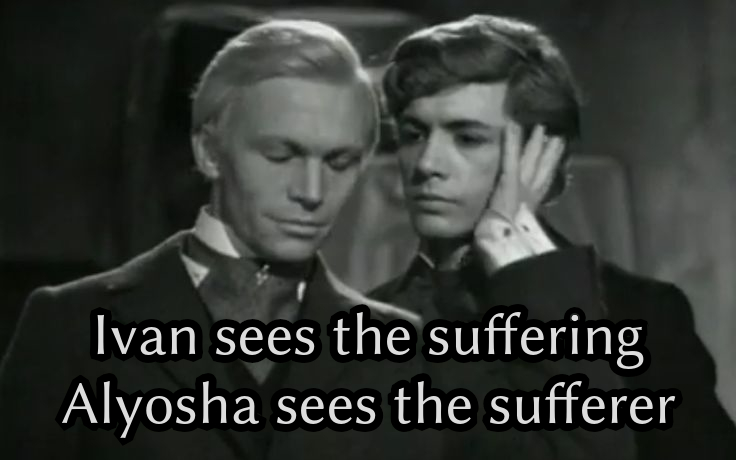
What he claims to not accept is the world created by God, and would continue to do so even as divine salvation presented itself to him. What Ivan cannot do is pardon God for permitting innocent suffering. Thus, he treats his rebellion as a moral duty, as though reconciliation by accepting reality would betray the victims he speaks for. But this compassion is not pure—Ivan arrived at it out of intellectual arrogance, and expresses it through passionate disdain. It becomes proof of Ivan’s own righteousness rather than an act of love. Christlike love asks nothing in return.9 Ivan’s compassion, by contrast, is an instrument for his intellectually and emotionally perceived righteousness. Ivan is aware that this makes his world one of pain, and wishes for his Christian brother, Alyosha, to heal him.
Alyosha can see how Ivan’s thoughts and ideas have gripped and possessed him to the point of delirium. This is very demonic, in a sense that the Russian author had explored in a previous work.10 We can see this on full display later in the novel, where the sick and delirious Ivan explains that he’s been visited by a devil.
His hallucination of the devil is a product of his own mind, his repressed self, a form of his Jungian shadow:
You are the embodiment of myself, but only of one side of me… of my thoughts and emotions, though only those that are most loathsome and stupid.
—Ivan Karamazov11
Thus, every thought carried by the fiend is a misrepresented, but true thought of Ivan. He acknowledges these thoughts, but struggles hard with them. This is because, without accepting God’s world, all that Ivan can achieve with his reasoning is cynicism and farce. The devil mocks Ivan’s belief in science with a parable: a nihilist is sentenced to walk a quadrillion kilometers before Heaven’s gates open to him, which he lies down against “out of principle” for a thousand years. He finally accepts the sentence, only to find on arrival that the walk was over in an instant. At this, Ivan remarks that it was his own adolescent joke thrown back at him by his own mind.
But nevertheless, the devil is as real as Ivan’s subconscious remains unknown, and he taunts him with desiring naive faith:
Without suffering what pleasure would there be in it? Everything would turn into one single, endless church service: much holy soaring, but rather boring. Well, and I? I suffer, but even so I do not live. I am the “x” in an indeterminate equation. I am one of life’s ghosts, who has lost all the ends and the beginnings, and even at last forgotten what to call myself. […] You are eternally angry, you would like there to be nothing but intelligence, but I will tell you again that I would renounce all this empyrean existence, all these honors and ranks just in order to be able to take fleshly form in the person of a seven-pood merchant’s wife and set up candles to God in church.
—Ivan’s devil
The devil claims that, unlike Mephistopheles,12 he loves truth and sincerely desires good. When the devil saw Jesus die on the cross, he did not shout “Hosannah” because the world would have gone extinct, and thus he remains with his loathsome deeds.
In my view it is not necessary to destroy anything, all that need be destroyed in mankind is the idea of God, that is what one must proceed from! […] Once mankind, each and individually, has repudiated God […], then of its own accord, […] the whole of the former world-outlook and, above all, the whole of the former morality, will collapse, and all will begin anew.
—Ivan’s devil
We can hear clearly how Ivan yearns for the truth and for devotion before creation. But unable to let go of his pride, he has to shut the doors to his hell and continue his torment, in fear of what were to happen, should he exit.
When the devil claims that Ivan’s dream is to take irrevocable, fleshly form as a fat woman who believes in all the things she believes in; going to Church with a pure heart, he alludes that Ivan’s wish is to be rid of his intellectualism. But this also reveals that his view of the higher truth is still rendered through the intellectual lens, hence it is only through ignorance that he believes he can be set free.
Of course, the intellect does not negate the subjective experience of truth, but when it is held as the supreme truth, it will severely limit how the truth can be experienced. The inability to do so is the mental hell Dostoevsky urges us to stay clear of.
What follows from the clean slate of the “death of God” was an existential question Dostoevsky grappled with. Here it is worth noting that Ivan in many ways resembles Dostoevsky’s contemporary, Friedrich Nietzsche, to whom he is often compared. There is no evidence that suggests that the Russian was acquainted with the thoughts of the German thinker. They were both ill in life, and their views on the essential role of suffering differs not in the means,13 but in the name. Nietzsche’s nihilistic position is not the negative form that Ivan suffers, but a very positive one.14 Suffering can be done in solitude or in God’s presence, and likewise can acts bloom with beauty and love with or without invoking His name. Where positive positions like Nietzsche and Alyosha still differ is in their outlook. Alyosha affirms the world and acts with devotion, whereas Nietzsche is inseparable from his bitter attitude. Of course, Alyosha is a fictive character, and Nietzsche was human… all too human.
Addiction to Suffering 🔗
Dostoevsky was intimately familiar with the subject of addiction and its self-destructive nature. He used himself as a model for the protagonist of The Gambler.15 In the novel, he makes it evident that the addict is not interested in the obvious path to material well-being and love.
Comedian and chronic gambler Norm Macdonald explains this:
So why the attraction? Most people would think: ‘It’s the wins that keeps the gambler going,’ but any gambler knows that this is not true. As you place your chips on the craps table, you feel anxiety and impatience. When the red dice hit the green felt with a thunk, and you’re declared the winner, and the chips are pushed towards you, you feel relief. Relief is all… and relief is fine… but hardly what a man would give the whole rest of his life to gain… it has to be something else. And the best I’ve come up with is this: it is a particular moment, a magic moment, that occurs after the placing of a bet, and before… the result of that bet. It is after the red dice are thrown, but before they lie still on the green felt where they fall; it is when the dice are in the air, and as long as they are there… time stops. As long as the red dice are in the air, the gambler has hope. And hope, is a wonderful thing to be addicted to.
—Norm Macdonald16
Perception of time is a strange thing, yet its tendency to flow and slow as states of consciousness flux is widely known. At its apex, time stands completely still, and the experience can endure for what feels like forever. These moments can be labeled verticality, standing in orthogonal contrast to the horizontal axis of time. The gambler lives on vain hope, sustaining moments of verticality from which they will inevitably return. Closely related to this hope is the thrill in the prospect of losing everything—for the gambler, ruination comes financially; for the daredevil, physically. Both hope and thrill are ways of dancing with the dimensions of time, holding the world still for a moment. From the outside, the addict persists through these short moments, inevitably failing at their attempted escape.
Outside these high-points, the world turns increasingly dull and sluggish by contrast. The external world remains as joyous as it ever was to an onlooker, but the addict’s faltering Self views it through gray-tinted glasses—and it is this misery, not the high itself, that the addict comes to need, since only against a sufficiently gray backdrop does the next high still register as vertical to rise above it. Loathsome suffering becomes the defining trait of the addict, and eventually an addiction in its own right, entirely apart from whatever substance or risk first produced it. The Underground Man17 is the archetypal figure here: he arrives at this suffering without any substance at all, feeding on his self-loathing the same way the addict feeds his pipe. His tenacity in refusing salvation is as powerful as whatever draws the gambler back to his prospect of hope.
A person like Ivan or the Underground man would rather remain miserable than accept salvation. Liza offers him love—hers to give, and, for the first time, his to receive and return. But self-loathing beats pleasure as an addiction: the Underground Man treats himself with utter seriousness because he needs his pessimism to stay intact. Should he accept salvation through Liza, he would cease to be—which he unconsciously fears more than any misery.
This twisted enjoyment of torment is the meaning of the line, “the gates of hell are locked on the inside,”18 penned by C.S. Lewis, no doubt.
These are all angles of the same vain attempt at escape from one’s conscious presence in the world—pleasure, risk, and, with the Underground Man, suffering itself, are simply different doors out of the same room. At the root of all three is the addict’s fear of being himself in the world, of confronting reality and himself as they are. For some this confrontation is surely too difficult; for others, the addiction is preferable to the prospect of a world without it—for who would they be, without their vice?
Der Steppenwolf’s Inability to Enjoy Life 🔗
Hermann Hesse’s self-proclaimed “Steppenwolf,” Harry Haller sits as the limit case of the diagnosis and cure. Haller seems to have done everything right, having gained immense knowledge on the subject, reading the Buddhist canon and Dostoevsky’s works. But, “one thing he had not learned, however, was to be satisfied with himself and his life.” His intellectualism, it turns out, is only part of the problem—the deeper obstacle he faces is the same as the addict faces: not a lack of knowledge about himself, but a refusal to meet himself without the meditation of that knowledge.
Unlike Ivan Karamazov who carries his world-contempt dressed as righteousness, and the Underground Man who has made world-contempt his retreat from transformation, Haller bares the pain after embarking on the positive path. What he has contempt for is himself:
During that period I became increasingly aware that the illness he was suffering from didn’t stem from any deficiencies in his nature. On the contrary, he had strengths and talents in abundance, but had never managed to combine them harmoniously, and that was his only problem. I came to realize that Haller had a peculiar genius for suffering, that he had, in the sense that Nietzsche intends in many of his aphorisms, trained himself to the point where his capacity for suffering was masterly, limitless, awesome. At the same time I realized that his pessimism wasn’t based on contempt for the world but on self-contempt, for however ruthlessly critical he could be when condemning institutions or individuals, he never spared himself. He himself was always the first target of his barbed remarks, the prime object of his hatred and rejection.
—The narrator, in Hesse, Der Steppenwolf
This pessimism Haller bears about the bourgeoisie life, which he views himself as verrückt (“displaced”) from, it condenses into the personality of the Steppenwolf, who is made for a world other than this. Like the Underground Man, in a defeated state, he finds himself in the embrace of a woman versed in the ways of the flesh. She nurtures him through her natural feminine devotion, and lectures him on his obvious flaws just the same. “Come on, how can you say you’ve gone to a lot of trouble to make something of your life when you don’t even want to dance?”19
Where Ivan Karamazov believes that he might be saved, but never genuinely tries, Haller is reluctant, yet open to try any means that might yield him salvation. He rediscovers vigor and is able to have a jolly good time dancing through the Weimar Jazz saloons.
Dancing does not cure this by itself. Haller could conceivably have turned the ballroom into one more high, one more suspension of time to chase, no different in kind from the gambler’s dice in the air. What actually opens him to change is something adjacent to the dancing: through Hermione, and later through Pablo’s magic theater, he gains the capacity to look at himself without flinching and without needing to perform the looking as a feat of suffering. This is the beginning of what Hesse insists is one of the supreme skills for finding peace in life—humor.
With humor, one is able to find genuine peace amidst internal and external chaos. Had the Underground Man been capable of laughing at himself, he might not have needed to wound Liza to keep his suffering, and by extension himself, intact. But the hypothetical undoes itself on inspection: a man capable of that laughter is a man no longer afraid to face himself, which is to say he would not have been the Underground Man at all.
Haller can intellectualize his troubled circumstance, and see the humor in it, but he can never unite the two. Only when he, at the end of the novel, realizes this, is he able to move forward. To both see the joke and be able to live under it with the pain is a dreaded experience for most. The capacity to endure it can surely be trained, but moving forward with success requires different insights and demands different means. In the next essay, Der Steppenwolf will be used as a case study for his failure of both the Apollonian and the Dionysian paths (which may lead others beyond the threshold).
Conclusion 🔗
Those who cling to the premise of their initial theory—treating the biological as merely material, the beautiful as merely felt, the Self as merely its suffering—will mistake the limit of their method for the limit of the thing itself. They will not let the mystery unfold past where their method can follow.
By the time we reach the addict, it becomes clear that this clinging was never only an intellectual habit. What began with the waterfall as a question about beauty ends as a question about fear. To analyze the waterfall instead of standing before it is already a small refusal to meet the world as it is. Reason presents itself as a gateway to seeing the truth of the world, but one ought to be wary, for the Buddhist demon of dialectics sits as atop it, ready to lead one lost in the maze of “opinion.” And Ivan Karamazov, for all his professed love of the sufferers he defends, cannot forgive God partly because forgiveness would require him to stand before the world—and before his own smallness within it—without the shelter of his righteous rebellion. The pathetic addict merely performs, compulsively and without disguise, what the intellectual performs with more dignity: both are afraid of the unmediated encounter with the Self as it is, and both build a door to stand in instead of walking through it.
C.S. Lewis never says to stop thinking about the waterfall, nor does Buddhism condemn reason itself. Both instead ask that reasoning stop mistaking itself for the whole of the experience, in the cases where direct presence suffices.
Then what is the cure? Accept the epistemic limits with humility. Release the will from the bondaged mode that forces it to impose itself on behalf of desire, whether for knowledge or absence of awareness. Instead of willing/seeking to control and dominate with the intellect, one relaxes it, akin to wu wei, letting the will of the world and the will of oneself guide one to their harmonious function. This is a balance of intellect and experience, seriousness and humor, where neither is asked to do the other’s work, and neither is used as a door to hide behind.
The perfect road map is incomplete unless it is charted from the position of each—likewise it can never be drawn by the current Self, who lacks the premonition to say how the future Self will experience their present. Perhaps recognition that pain is unbearable is the first step, perhaps it is to recognize the essential nature of the laugh. Fellow struggler, we might yet find our way.
Reason may lead one to awakening, but awakening does not necessitate reason. Therefore, without going further into depth about the cause, we can take the Buddhist advice and pull out the poisoned arrow here and now. One might rightly question why I bother writing these words; why I providing dialectic discourse, instead of retiring into my arts and to my waterfalls. I do too, dear reader, but know that my lips bear a beaming smile that shall lead me on.
C. S. Lewis, The Abolition of Man (1943). ↩︎
“Ray Spider,” Wikipedia, accessed July 2026, https://en.wikipedia.org/wiki/Ray_spider. One genus, Plato, is named for its cave-dwelling habit; see “Plato (spider),” Wikipedia, accessed July 2026, https://en.wikipedia.org/wiki/Plato_(spider). ↩︎
Julius Evola, The Doctrine of Awakening (1943). ↩︎
Evola, The Doctrine of Awakening. ↩︎
Laozi, Tao Te Ching, esp. verse 1 and 78. Also the subject of a previous essay, fully explored in the video format: https://youtu.be/ecinhB-9USY?si=YcB2bmXwqJaQBFdU ↩︎
Evola, The Doctrine of Awakening. ↩︎
Fyodor Dostoevsky, The Brothers Karamazov (1880). ↩︎
Dostoevsky, The Brothers Karamazov. ↩︎
Also the Vedantic teaching of “acting without regard to the fruits.” Bhagavad Gītā 2.47-49. ↩︎
Fyodor Dostoevsky, Demons (1872). ↩︎
Dostoevsky, The Brothers Karamazov. ↩︎
Johann Wolfgang von Goethe, Faust I, verse 1336-1337 (1808): “[Ich bin] ein Teil von jener Kraft,/ Die stets das Böse will und stets das Gute schafft.” (Tr.: [I am] a part of the power that always would, desire Evil, but work for Good.) ↩︎
Friedrich Nietzsche, Ecce Homo (1888), “Why I Am So Wise,” §2. ↩︎
The existential creation of values proposed by the symbolism of the Child. Friedrich Nietzsche, Thus Spoke Zarathustra, “1. On the Three Transformations” (1883). The exuberance with which the death of God is explored. Nietzsche, The Gay Science, §108, §124, §143 (1882). ↩︎
Fyodor Dostoevsky, The Gambler (1866). ↩︎
Link to the audio: https://youtu.be/q0V-C5yr5sg?si=2BAoBeA_KZ9diKLO ↩︎
Fyodor Dostoevsky, Notes from Underground (1864). The protagonist. ↩︎
C. S. Lewis, The Problem of Pain (1940). ↩︎
Hermann Hesse, Der Steppenwolf (1927). ↩︎