Beginning with Meditation - Errors, Demons and Righteousness
Introduction ATTACH 🔗
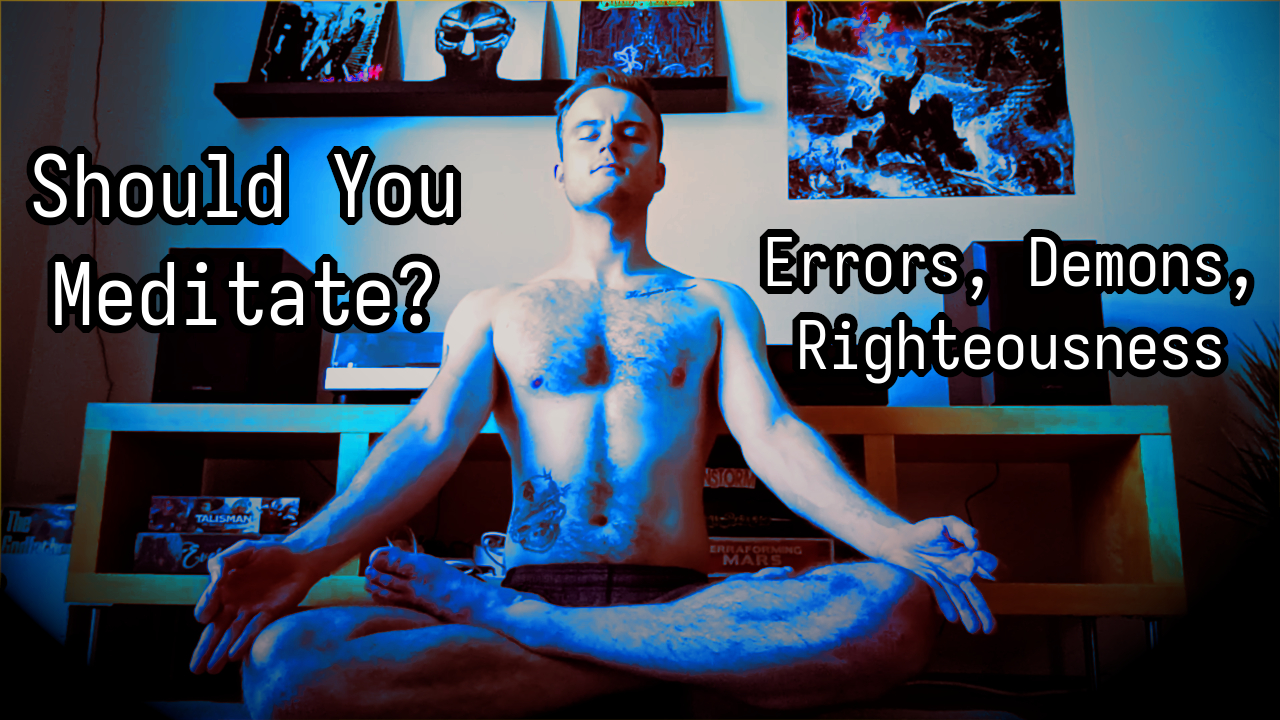
Meditation is held in high regard because of its difficulty, peaceful nature and gorgeous aesthetics, but does it surpass scrutiny? Since breaking my ignorance about the positive light the practice is held in, I’ve contemplated questions that followed. Today, I want to try to explain what contemplation and meditation are, who shouldn’t meditate, the dangers associated with this practice, demons especially, and finally what meditation can rightly be used for.
The following assumes that you are an amateur at spiritual practices; initiated monks stand to learn only from my errors. These thoughts are nevertheless intended for noble ones1 to apply in their individual lives, or possibly to guide a dear Other away from misdirection. This is therefore absolutely not grounds to harass or mock someone who tries to find peace in their life. I can see the following being rightly used to dispel illusions created by those that try to exploit the practice for attention or monetary motives.
Background 🔗
Contemplation and meditation are often conflated in the senses used colloquially and technically.
Contemplation is to engage with a mental subject such as an idea, question, image, or experience such as a memory. This is usually done through thinking, but it can be practiced in a mystical mode of a thoughtlessness.
Meditation tends to refer to a structured practice, often involving training of the conscious attention. Most common today is to meditate on the breath, but one could also meditate on a mantra, a sensation or the void of thought. These can be combined, such as sitting in an asana (physical pose) and breathing in a pattern and/or visualizing a deity. Even if one typically sits still during meditation, as one can meditate while on a walk, meditate when moving to a rhythm or other concentrated acts such as jogging or running. Having an intention with a meditative practice is essential to success. We’ll return to why that is.
Having rough ideas of these two terms, it should be evident that contemplation and meditation are not mutually exclusive.
Do or Do Not 🔗
Do or do not, there is no try.
—Master Yoda
Just like academic accomplishments shouldn’t be done for the sake of parents approval, one should not meditate to make someone else proud. For this reason, never recommend it to someone who is ignorant, because the ignorant person should absolutely not meditate. Assuming you’ve stumbled upon this text, then we can assume that you at least possess the potential to unveil your ignorance on this subject. We can test your ignorance with a simple thought experiment.
Ask yourself why you think you want to meditate? Is it because others respect the practice? Is it because of the aesthetics? Or are you unable to formulate a reason, but keep getting drawn to it. These questions contain a truth, but none is a valid reason. Ask yourself: within yourself, who is it that wants to meditate? … Now this is a conundrum—there is no one there; as soon as you start meditating to find out it ceases, yet there was a compulsion for you to try. One day you might realize why that is.
Another person that should avoid meditation is the strictly secular person, the one who thinks in their superstition that they should disbelieve in the soul because of its depiction in fiction or exoteric doctrine. One might come to the conclusion that the soul indeed exists, but one will be locked away from the true purposes of the practice so long as one refuses recognition of the Self.
However, if one’s soul is noble and one aims to master oneself, if one is curious about the experience of the internal realms, if one believes one may cultivate astral abilities or develop one’s conscious concentration, then keep reading to find out more.
Dangers of Meditation 🔗
Detachment or Dissociation 🔗
Contemplating or philosophizing too much risks making one detached from the ways of the world, especially the social. This should be obvious. Returning to it, for example, a conversation with a friend, one then struggles to speak words according to their colloquial meaning because of the technical context one has submerged oneself in. Another example would be to get so concerned with ontology that one cannot make mundane acts without questioning how they pertaining to the meaning of life. A paralysis or stultifying effect.
This detachment is prevalent for the novice who has been practicing the meditation known as “mindfulness.” The peace and tranquility creates a pleasant, numbing effect. The answers to it all seem too real, but indescribable, resulting in a dumbfounded state which is reset back to the default ignorance once the effect wears off. If one has experience with the psychedelic, one would know this as the contrast between the wholesome unity with reality and agitation over mundane burdens as the post-influence effects lessen.
The antidote to the danger of detachment is given by the blessed Lord Krishna in the Bhagavad-Gita. He informs us that karma-yoga, devotional service, is superior to renunciation.2 Karma literally means action and is associated with the consequences thereof, while yoga is the ascetic practice. Renunciation is detachment in its positive sense, that which plenty of monastic orders aim to perfect. Even still, a monk must never forget how to see the spiritual and philosophical truth in the form it assumes in the mundane. The spiritual master succeeds in all domains.
Spiritual Escapism 🔗
Meditation will never solve one’s problems on its own. Moving through discomfort is absolutely necessary to resolving any problem in one’s life, for each thing which can rightly be called a problem has a semblance in one’s own Self. One may use meditative clarity to build courage or become enlightened about the how, but enacting that is required for overcoming pain and progressing towards enlightenment.
What often ends up occurring, especially with ignorant people practicing mindfulness meditation, is that they develop an open awareness of the world which ironically is unaware of their Self. The common form this takes is to utilize meditation as a coping mechanism, and instead of confronting the self at the critical moments, they flee into the comfort of the thoughtless mode. But the conflict is never absolved by waiting alone. If one needs to wait, then let that be the honest declaration to the self, but never lie to oneself or fear it. Remember, that a void within is the apt place for possession.
Demons to Be Mindful Of 🔗
A demon is a force which may possess one, taking influence over one’s consciousness and actions. This sounds severe because of its association in culture, and at its worst it may turn into this, but not all possession is complete and not all demons are equal in power or ability to possess.
One example of a power that has innocent forms, but can culminate in a demonic possession is the underlying drive for many addiction cases. The impulse that drives people to addiction is a power of what may become a demon. A thing so simple as a cup of coffee can be enjoyed without vigilance and likewise does lust have its proper place. Yet there are plenty of people who get consumed by these things to the point of hazarding health and livelihood. Part of this is circumstance, part is developed traits, part is prenatal—the demonic has a place in all three. We need not digress into discussing the neurochemical pathways involved to realize that the potential for addiction contains aspects above biology. If addictive urge develops to the demonic degree, it will be pure force that compels one to self-destroy, a slow suicide. No wonder the behavior has earned the slang “fiendish.”
If one practices mindful meditation, one may start detecting demonic presences. One may see how they’ve possessed a past self or how they offer invitations in the present. This is speaking metaphorically, for they need not be visualized. The best way of describing them that I’ve found is currents. That’s how they feel; like something that would sweep one away or into a false form. One may detect these forces and hopefully be able to resist them if one roots one’s consciousness in one’s Self and in the mantra which is the intention of the practice.
Below are a few demons that one might encounter if one practices meditation as a novice:
1. Vanity 🔗
The thought or feeling of “I meditate. These other people can’t meditate, therefore I am superior to them,” that is the source of a demon and it is not a reason to be meditating. The allure may lie in the contrast between perceived aesthetics, quality of consciousness, self-control, et cetera, but as long as it is enacted to diminish another’s will, one is not deserving of respect, not mine, not the gods’, not the grace of the Truth.
2. Avarice 🔗
Avarice or greed is counted among the seven deadly sins of Christianity. While it tends to refer to the craving of material things, it may also refer to power. Meditating with the intention of increasing one’s power for its own sake, or with malicious intent of using said power, that is the source of a demon. Channelling or harnessing may have a righteous place, but generally it should be looked upon with caution.
3. The Fruitbearer 🔗
We already mentioned the danger of meditating as a coping mechanism, but this is but one of many forms the Fruitbearer demon appears. The worship of utility with no relation to righteous foundations is like trying to walk blindly in the dark—one does not know the reason for why one is doing it, just making little progress as one struggles to put their feet in front of them. In its severe state it is mindless productivity and burnout. Which is interesting, as those spaces tend to employ meditation as a crutch, often to enable further harvesting of fruits.
One can of course learn to navigate the dark with an inner light. Again we turn to Krishna for guidance, he instructs us to “act without regard to fruits of our work.”3 True actions are enacted for no other sake than the duty to oneself and the duty to the Truth.
4. Fallen Righteousness 🔗
This demon appears under the guise of virtue itself—it is the zealous inquisitor, convinced that its cruelty is justice.
Both sin and virtue stem from the same neutral phenomena. While every sin is a fallen, corrupted and/or otherwise negative form of something pure, every virtue likewise has a shadow. For righteousness, the same impulse that makes one protective can make one controlling, tyrannical or outright punitive. During this possession, the self-convincing may slip its hold of the consciousness: the pleasure or justice felt during the enactment of the “righteous” act, can then be seen for the wickedness it is.
The person one wishes to correct may indeed bear responsibility for their own situation—be it ineptitude, weakness, or the karma thereof. This is always true to an extent, which is what gathers the justified sense of acting “righteous” towards them. Truth alone is never a license for vigilantism; judge, jury and executioner as one is disorganized and unregulated. Additionally, does the fact that someone’s suffering is self-caused justify oneself repressing their spirit further? What kind of force does it take to push a person down—especially in a matter that has no bearing on the perpetrator’s own life?
By all means, one can and should hold themselves to the righteous standard, if one has the character for it. The same power that turns demonic can be turned inward, which may cause either harm or an eradication of the demonic itself. One has less responsibility here, for one can know what one’s own character is capable of. But never extend that force outward onto another’s path uninvited.
Consider, too, that the apparent victim is demonic and hostile—something one shouldn’t tolerate, or at least turn a blind eye to while in its proximity. If they lack insight and control, but one is not aware of what they truly need, then one’s righteous actions will likely just worsen the situation. Through love, hearts may be swayed, but one’s own power to do so is limited, so use it wisely. Sometimes the wiser act is to leave them to their fate.
5. Personal Demonic Potential 🔗
Labelling a demon when it appears, calling it out by name, requires one to recognize it and gain the knowledge to see it for what it is. This is not easy to do before having experienced their presence. We can suppose that religious scripture describes forms of these forces, but how communion is experienced is obviously too difficult to describe in that format.
In the deep beyond, there lie powers that few know, but even in the immediate unconscious realms, one can be unfortunate to have a powerful personal demonic potential. One has no idea how strong its grip can hold when it presents an allure tailored to exploiting one’s particular weakness and past pains.
The benefit of it occurring during meditation is that the practice is controlled and one can prepare accordingly. If, instead, it takes form during a distressed state such as after a conflict with a partner or friend, or during grief following a loss, then it may gain wider influence due to one’s low watchfulness.
Psychotic Break in the Beyond 🔗
Going in deep without a guide or a strong connection with one’s soul, one risks losing oneself to what one encounters, and most likely, one finds nothing and wastes one’s time.4
This phenomenon in the deep is especially likely to occur during psychedelic experiences, since a potent dose will plunge one straight there without consent. Without a firm sense of self, one risks psychosis and learning nothing, whereas the steady soul, going in with intention, and/or guided by a guru, may attain wisdom through the experience. The one who continues to delve deep ever deeper may be confronted with a demons dwelling within or stronger, cosmic forces, and that is not for the faint of heart.
Applications for Meditation 🔗
Despite the dangers there are good reasons for one to meditate. I’ve listed a few.
Initiating Spiritual Realization 🔗
The meaning of life according to perennialism can be summarized as: realize oneself, then actualize oneself according to the laws of the universe. Even if one approaches it from positive atheism or positive nihilism, thereby not framing it with the religious context, this is the likely truth one will find.
While the final path to realization doesn’t require meditation for all, it is part of initiation circles, which is because successful meditation demonstrates the ability to concentrate and connect with the astral.
Mastery of the Mind, Mastery of the Body 🔗
Meditation is far from the only path to somatic and mental mastery, but it is still a challenge a master of life must be able to face.
Could one rightly call themselves a man if they lacked the will and/or self-control to dedicate themselves to doing nothing for half an hour? Enough with the attempts to wriggle away from this inability with excuses that it wastes time. If one has the time to read this text, then they for sure have time enough to spend not doing anything.
Perfecting this control is far beyond my knowledge and capabilities, hence why this is addressed to fellow amateurs.
Enhanced Mental Abilities 🔗
While the desire for power to impose their will onto others, or increase it for its own sake, runs contrary to the ascetic doctrine, the pursuit of power to enact one’s duty is a valid reason. Perfecting one’s ability to concentrate will allow one to apply it in other domains with prospering effect.
If one discovers the underlying principles of the mental abilities, one will realize their applicability to general situations. For example, to the extent that these principles are universal, knowledge of them can also be used to navigate other people. By this, I mean that if you know how your own mind operates, then you will have an idea of the mind of another will. Reading people is a subtle ability that merits its own essay, but predicting words or thoughts with moderate accuracy is not difficult. Again, I urge responsibility.
Detection of Thoughts and Demons 🔗
During the initial meditative practice, the means with which one reaches de-identification will create a passive vigilance against intrusive thoughts. Evola describes three techniques in The Yoga of Power that illustrate this:
- Retracing thoughts to their source: as thoughts occur without one’s consent, instead of getting agitated, one notices at some point, and from there retraces the thought process to its source.
- The Shepherd’s Exercise: “[o]ne’s inner attitude resembles that of a shepherd who leads his flock to the pasture and lets it roam free, without ever losing sight of it.”
- The cutting-off method: remaining alert and suppressing every thought and mental image at its first appearance. “Just as a quick, clean slash with a sickle easily mows down a blade of grass.” This is repeated until one experiences a flight of thoughts and images, a “view of the fleeing enemy.”5
Through all of these, but especially the cutting-off method, one can learn to defend oneself from harmful thoughts and powers that could otherwise develop into the demonic. Like previously mentioned, this is aptly applicable to social situations, where irritation and similar thoughts can be kept from intruding. Of course negative thoughts shouldn’t be neglected before they are understood, but this often takes too much time and effort when one has work to be done.
Dispelling Ignorance 🔗
When mentioning that the ignorant person shouldn’t meditate, it referred to a particular type who is defined by their ignorance. They may earn the names pashus,6 sheep, the last men,7 or modern slang such as normies or NPCs. However, ignorance comes in many forms and affects practically all individuals.
There is an impulse that compels people to mindless activities such as the modern phenomenon of doom-scrolling. If one, through meditative practices is able to gradually dissolve that impulse, one then stands to rediscover the beauty of the natural world that one lost as one’s mind was absorbed on stress. Chirping birds, majestic trees, and the vast skies makes the soul dance. The beauty is always there, we are just too ignorant to see it, echoing Dostoevsky’s words.8
Conclusion 🔗
If you end up finding meditation boring or confusing, then you likely don’t know how to do it correctly or why you are doing it at all. Again we need to stress that the intention with the practice is essential; without it, you will get lost and distracted.
You might give mediation an honest try and come to recognize that it is not for you—it might rightly be so, and that is nothing to be ashamed about. If your soul is more Faustian/Dionysian than it is Apollonian, then the self-realization and -actualization will likely require dynamism as opposed to stasis. Nevertheless, the ability to meditate is still advised that one develops as a baseline skill.
Meditation is a very special practice, and I’ve yet to contemplate and meditate on why exactly that is.
Until next time.
The sense used by Julius Evola in works such as The Doctrine of Awakening (1943). ↩︎
Bhagavad Gītā 5.2. ↩︎
Bhagavad Gītā 2.47-49. ↩︎
Rudolf Steiner, The Way of Initiation (1910). ↩︎
Julius Evola, The Yoga of Power, chapter 6 (1949). ↩︎
“Animal,” from the verb pac, “to bind”. It is used to designate those who are subject to primitive urges, conformists lacking knowledge. Evola, The Yoga of Power, chapter 5. ↩︎
The inverse of Nietzsche’s Übermensch. Friedrich Nietzsche, Thus Spoke Zarathustra (1883). ↩︎
Fyodor Dostoevsky, Brothers Karamazov, book 5, chapter 2 (1880). ↩︎